Protective film may look like a simple layer of plastic with adhesive, but its performance depends on a carefully balanced combination of mechanical, adhesive, optical, and cleanliness properties.
For industrial buyers, evaluating a temporary protection film only by thickness or price can be misleading. A thicker film is not necessarily better, and stronger adhesion does not necessarily mean better protection.
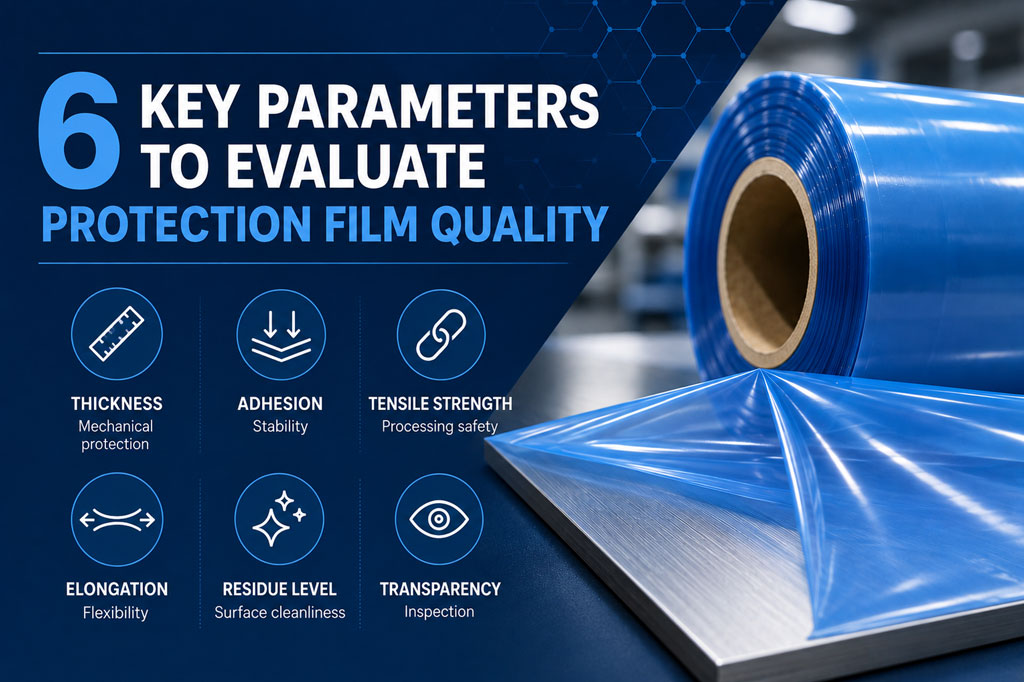
For procurement teams, engineers, and manufacturers, the following six parameters provide a practical framework for evaluating protective film quality.
| Parameter | Why It Matters |
|---|---|
| Thickness | Mechanical protection |
| Adhesion | Stability |
| Tensile strength | Processing safety |
| Elongation | Flexibility |
| Residue level | Surface cleanliness |
| Transparency | Inspection |
1. Thickness: More Than Just Film Weight
Thickness is one of the first parameters buyers consider because it directly influences mechanical protection.
Temporary protective films are commonly manufactured in different thickness ranges depending on the substrate and application. A relatively thin film may be sufficient for smooth surfaces requiring protection mainly against dust and light handling, while thicker films may be preferred when surfaces face greater risks of scratching, impact, bending, fabrication, or transportation damage.
Thickness affects several characteristics simultaneously:
- Puncture and tear resistance
- Scratch protection
- Film stiffness
- Conformability
- Handling during application
- Material consumption and cost
However, thicker does not automatically mean higher quality.
For example, increasing thickness may improve physical protection but also increase material costs and reduce flexibility around complex profiles. The objective should therefore be to select the appropriate thickness for the actual damage risks rather than simply specifying the thickest available film.
For manufacturers using automatic laminating equipment, thickness consistency is also important. Significant variation across the film can affect web tension, winding quality, and application stability.
What buyers should evaluate
Instead of asking only:
“How many microns is the film?”
A better question is:
“How consistent is the thickness across the roll, and what thickness is appropriate for my production process?”
2. Adhesion: The Most Application-Sensitive Parameter
Adhesion determines whether the protective film remains securely attached to the substrate throughout its required protection period.
If adhesion is too low, problems may include:
- Edge lifting
- Film movement
- Peeling during cutting or forming
- Contamination entering between the film and substrate
If adhesion is too high, another set of problems can appear:
- Difficult removal
- Film stretching during peeling
- Adhesive transfer
- Surface marking
- Higher labor requirements during removal
This makes adhesion one of the most application-specific parameters in protective film selection.
A polished stainless-steel sheet, powder-coated aluminum profile, plastic panel, glass sheet, and textured metal surface can all require different adhesion levels.
Surface roughness is particularly important. A film that performs well on a mirror-finished metal surface may have insufficient effective contact area on a textured surface.
Don’t evaluate adhesion in isolation
A common purchasing mistake is comparing two films purely according to their published peel adhesion values.
The same nominal adhesion value does not guarantee identical real-world performance.
Actual performance can also be affected by:
- Surface energy
- Surface roughness
- Coating chemistry
- Application pressure
- Temperature
- Aging time
- Storage conditions
For customized protective film, matching the adhesive system to the actual substrate is usually more important than maximizing adhesion strength.
3. Tensile Strength: Protection During Processing
Protective film often remains on a product while that product undergoes additional manufacturing operations.
Depending on the application, these may include:
- Cutting
- Stamping
- Bending
- Roll forming
- Drilling
- Handling
- Transportation
- Installation
During these processes, the film experiences mechanical stress.
Tensile strength indicates how well the film can withstand pulling forces before breaking.
A film with inadequate tensile properties may tear during application or processing, resulting in exposed areas of the substrate.
Tensile strength also matters during removal. Ideally, workers should be able to peel away relatively large sections of film rather than repeatedly removing small torn pieces.
For automated production lines, stable mechanical properties become even more important because film is continuously unwound and laminated under controlled tension.
Unexpected breakage can interrupt production and reduce overall line efficiency.
4. Elongation: The Film’s Ability to Adapt
Tensile strength tells us how much force a film can withstand; elongation tells us how much it can stretch before breaking.
This becomes particularly important when protective film is applied to products that are subsequently bent, formed, stamped, or otherwise processed.
A film with insufficient elongation may crack or split when the substrate changes shape.
Higher elongation can help the film accommodate:
- Curved surfaces
- Profile geometry
- Bending
- Forming operations
- Dimensional changes during processing
But elongation should always be considered together with tensile strength.
A film that stretches extensively but lacks sufficient mechanical strength may deform too easily. Conversely, a very strong but insufficiently flexible film may tear when the protected component is formed.
The real target is therefore a balanced tensile-strength-to-elongation relationship suitable for the customer’s manufacturing process.
5. Residue Level: The Parameter You Notice After Removal
Some protective film quality problems are invisible during application.
They appear months later—when the film is removed.
Adhesive residue can create significant problems for manufacturers because the protected surface may require additional cleaning before painting, assembly, installation, packaging, or delivery.
Potential consequences include:
- Additional cleaning labor
- Solvent consumption
- Production delays
- Surface contamination
- Customer complaints
- Product rejection
Residue risk can be influenced by adhesive formulation, substrate chemistry, temperature, UV exposure, storage duration, and protection time.
This is why a short room-temperature peel test alone may not provide enough information for demanding applications.
Aging performance matters
Consider two films that both remove perfectly after 24 hours.
Film A still removes cleanly after several months of storage and temperature exposure.
Film B gradually develops higher adhesion and eventually leaves adhesive traces.
Their initial specifications may appear similar, but their actual protective performance is very different.
For applications involving long transportation periods, outdoor exposure, elevated temperatures, or extended storage, aged removability should be treated as a critical quality parameter.
6. Transparency: Important When Inspection Must Continue
Transparency is sometimes considered a cosmetic property, but in many industrial applications it has a practical function.
Clear protective film allows operators and inspectors to examine the underlying surface without removing the protection.
This can be useful for products such as:
- Stainless-steel sheets
- Aluminum panels
- Glass
- Plastic sheets
- Decorative surfaces
- Appliance panels
- Electronic displays
Good optical clarity makes it easier to identify scratches, dents, coating defects, contamination, or other surface imperfections during production and quality inspection.
Transparency can therefore reduce unnecessary film removal during intermediate inspection.
However, maximum transparency is not necessary for every application.
Blue, black-and-white, printed, or other colored protective films may instead be selected for identification, UV protection, branding, processing recognition, or installation instructions.
The key question is not whether the film is perfectly transparent, but whether its optical properties support the intended production workflow.
Quality Is About Balance, Not One Maximum Specification
One of the most important principles when evaluating protective film is that there is no single parameter that defines quality.
Consider the following film:
- Very thick
- Extremely high adhesion
- Excellent tensile strength
It might appear to be a premium product on paper.
But if it is difficult to remove and leaves residue after three months, it may be completely unsuitable for the application.
Likewise, a thinner film with carefully controlled adhesion, sufficient mechanical strength, good elongation, and clean long-term removability may provide much better overall performance.
Therefore, protective film quality should be evaluated as a performance system:
Substrate + Adhesive + Film + Manufacturing Process + Environment + Protection Time
Changing any one of these factors can change which film specification is appropriate.