Protective film has traditionally been viewed as a simple industrial consumable. Its job is straightforward: protect finished surfaces against scratches, dust, stains, fingerprints, and other damage during manufacturing, transportation, fabrication, and installation.
But protective film does not have to be only a protective layer.
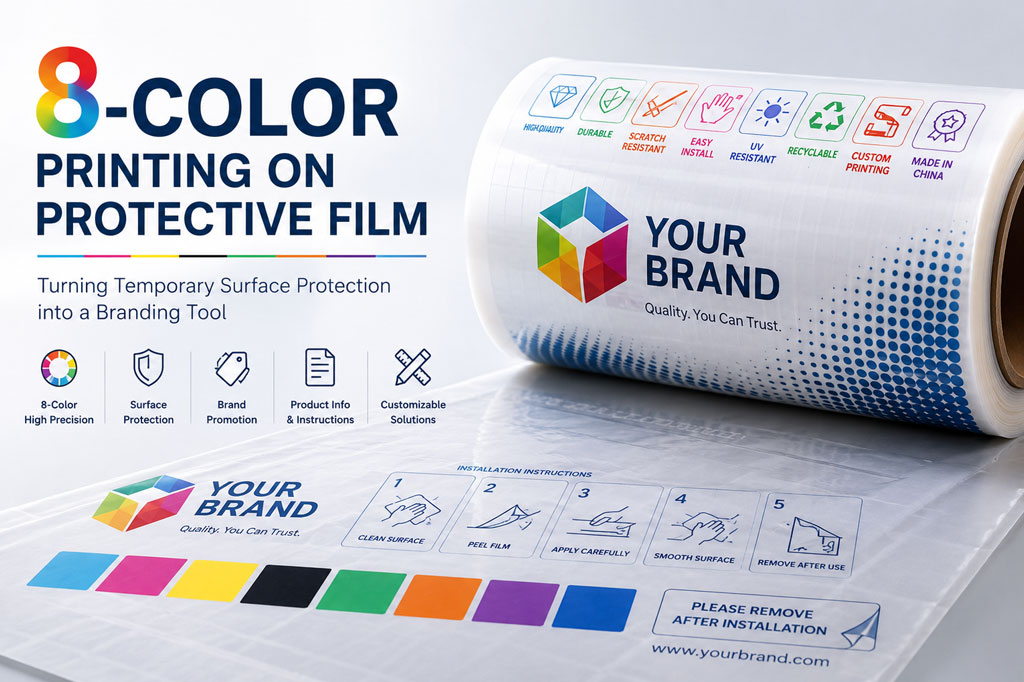
With our advanced up to 8-color printing, temporary surface protective film can become a highly visible communication medium—carrying company logos, brand colors, product information, installation instructions, safety messages, QR codes, and other customized content.
From Protective Consumable to Communication Surface
Consider how protective film moves through the industrial supply chain.
It may be applied at the original manufacturer’s production line, remain on the product during processing, travel through warehouses and distributors, arrive at a construction site or assembly plant, and stay attached until final installation.
During this entire journey, the film occupies a large and highly visible surface.
An unprinted film uses this space only for protection. A custom-printed film can perform several functions simultaneously:
Surface Protection + Branding + Identification + Instructions + Communication
This is fundamentally different from printing a logo on a shipping carton.
Cartons may be removed when products enter a warehouse or jobsite. Protective film, however, often stays directly on the product until close to the final stage of use. The branding therefore travels with the protected surface itself.
That makes protective film a potentially valuable but often overlooked brand touchpoint.
1. Multi-Color Logos Make Protective Film Instantly Recognizable
Single-color printing is sufficient for basic identification, but it can significantly limit brands whose visual identity depends on multiple colors.
Up to 8-color printing gives manufacturers much greater freedom to reproduce more complex visual designs.
For example, a protective film can incorporate:
- Multi-color corporate logos
- Brand names and slogans
- Graphic elements
- Product series identification
- Distributor information
- Repeating brand patterns
Instead of simply printing a black company name every 500 mm, manufacturers can develop a repeating branded design across the entire film.
This can be particularly useful for manufacturers whose products pass through multiple intermediaries.
Imagine bundles of aluminum profiles from several suppliers stored in the same warehouse. If one supplier uses a distinctive printed protective film, workers, distributors, installers, and customers can recognize that brand before the film is removed.
In this case, protective film becomes part of visual product identification.
2. Maintaining Brand Colors Across the Supply Chain
Brand recognition is not created by a logo alone. Color consistency can be equally important.
Many industrial manufacturers invest heavily in standardized corporate colors across websites, catalogs, exhibition booths, product packaging, vehicles, and factory signage. Yet their protective films may still use generic blue, transparent, or black-and-white printing.
Multi-color printing makes it possible to bring more of that visual identity onto the film itself.
For example, a manufacturer might combine:
Transparent PE film + corporate blue logo + red product series mark + black technical information.
Another company could use a white or blue film as the background and create a repeating graphic system based on its corporate colors.
The objective does not necessarily have to be photographic reproduction. For industrial protective film, the more important goal is usually recognizable, repeatable and production-friendly branding.
This distinction matters.
A protective film is not a brochure. Good protective film design should remain recognizable when viewed from different angles, partially covered, cut into smaller sections, or wrapped around long profiles and large sheets.
3. Product Information Can Travel Directly With the Surface
One of the most practical advantages of custom printing is that important product information can remain physically attached to the product.
Depending on the application, printed information may include:
| Printed Content | Potential Purpose |
|---|---|
| Product model | Product identification |
| Manufacturer | Brand recognition |
| Production information | Traceability |
| Product grade | Material differentiation |
| Surface finish | Prevent product mix-ups |
| Contact information | Supplier identification |
| Website | Customer access to information |
| QR code | Link to digital documentation |
| Certification marks | Communicate relevant compliance information |
This is especially useful when visually similar products have different specifications.
For example, two stainless steel sheets may look almost identical while having different surface finishes or grades. Different aluminum profile series may also share similar appearances.
Printed protective film provides an additional identification layer without permanently marking the finished surface.
Once the product reaches its final destination, the film can be peeled away together with the temporary information.
That is one of the unique characteristics of this communication medium: the information lasts approximately as long as the protection is needed.
4. Installation Instructions Can Reduce Mistakes
Branding does not have to be the only purpose of printing.
Protective film can also become an operational communication tool.
For construction materials, panels, doors, windows, aluminum profiles, decorative surfaces, and other installation-related products, manufacturers can print simple instructions directly onto the film.
Examples include:
- “REMOVE FILM AFTER INSTALLATION”
- “THIS SIDE OUT”
- “DO NOT REMOVE BEFORE FABRICATION”
- “PEEL WITHIN 30 DAYS AFTER INSTALLATION”
- “KEEP AWAY FROM DIRECT SUNLIGHT BEFORE REMOVAL”
Directional arrows, handling symbols, installation sequences, warnings, and QR codes linking to installation manuals can also be incorporated.
This approach places information where workers actually need it: on the product they are handling.
A manual inside a carton can be lost. A sticker can fall off. Installation instructions printed repeatedly across the protective film remain visible throughout handling and installation.
For manufacturers, this means printed film may contribute not only to marketing but also to reducing avoidable handling and installation errors.
5. Eight Colors Do Not Mean You Should Always Use Eight Colors
One important point is often overlooked when discussing 8-color printing capability.
The objective is not to use as many colors as possible.
Eight-color capability should instead be viewed as increased design flexibility.
A simple industrial application may require only two colors. Another brand may need four or five colors to reproduce its identity correctly. A more sophisticated design may benefit from six, seven, or eight printing units.
The printing specification should therefore follow the communication objective rather than the maximum capacity of the printing machine.
Too much information can actually reduce effectiveness.
For most protective film applications, a strong design hierarchy works better:
Brand → Product → Key Instruction → Supporting Information
The logo should be immediately recognizable. Critical instructions should be readable from a practical working distance. Secondary information can remain smaller.
This turns protective film into a designed communication system rather than simply a film covered with text.
6. Protective Film Creates Repeated Brand Exposure
The branding value becomes even more interesting when we consider how protective film is actually seen.
A printed carton may show a logo four or five times.
A large roll of protective film can repeat a logo hundreds or thousands of times.
When applied to metal sheets, panels, glass, profiles, doors, cabinets, or appliances, the repeated pattern can create a temporary branded surface across an entire warehouse, production line, fabrication workshop, or construction site.
This repetition can generate exposure among audiences that conventional advertising may rarely reach:
fabricators, distributors, warehouse workers, installers, contractors, project managers, purchasing personnel, and end customers.
For B2B manufacturers, these audiences can be particularly valuable because many are directly involved in product selection or supplier recommendations.
7. Different Printing Strategies for Different Applications
There is no universal printed protective film design.
An aluminum profile manufacturer, for example, may prioritize repeated logos, company website, profile series, and removal instructions.
A stainless steel sheet manufacturer may emphasize material grade, surface finish, processing direction, manufacturer identification, and handling warnings.
A glass manufacturer might focus on brand identity, glass specifications, installation orientation, and QR-linked technical documentation.
A decorative panel manufacturer could use more visually sophisticated multi-color graphics because appearance and branding play a larger role in the customer’s purchasing experience.
An OEM appliance manufacturer may prioritize production codes, component identification, handling information, and assembly instructions.
The real advantage of multi-color printing is therefore not simply aesthetic customization. It is the ability to design the protective film around the information requirements of a specific supply chain.
8. QR Codes Connect Temporary Film With Digital Information
Protective film is temporary, but the customer journey does not have to end when the film is removed.
Printing a QR code can connect the physical protected product with digital resources such as:
- Installation manuals
- Product specifications
- Technical data sheets
- Warranty registration
- Maintenance instructions
- Product authentication
- Company websites
- Distributor portals
- After-sales support
This creates an interesting combination of temporary and permanent communication.
The protective film acts as the temporary physical interface, while the QR code directs customers toward longer-lasting digital information.
For industrial manufacturers increasingly pursuing digital traceability and after-sales engagement, this can give protective film a role beyond conventional packaging.
Conclusion
8-color printing expands what temporary surface protective film can accomplish.
Multi-color logos and corporate colors strengthen visual identity. Product information helps distinguish materials and specifications. Installation instructions place important information directly in front of workers. QR codes connect physical products with digital documentation.
But the greatest opportunity is not simply printing more colors.
It is recognizing that the large surface area already being used for protection can simultaneously become a communication channel.