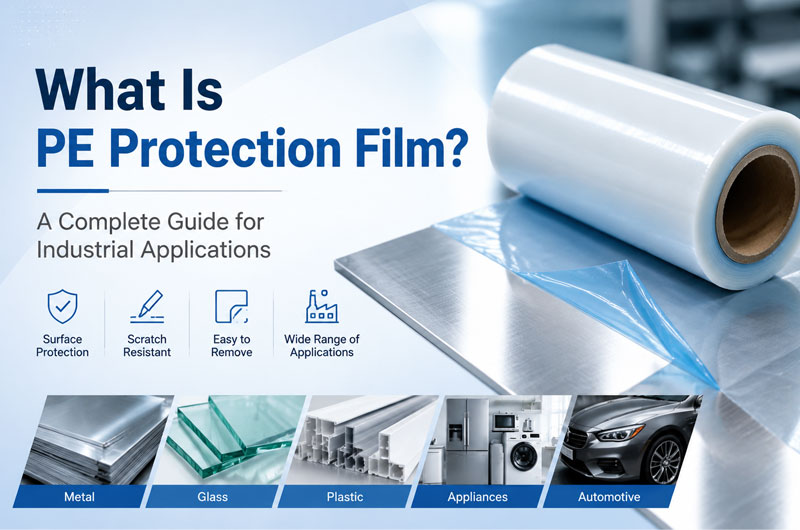
In manufacturing, transportation, and surface finishing industries, protecting products from scratches, dust, contamination, and handling damage is critical. PE protection film has become one of the most widely used temporary surface protection solutions due to its flexibility, cost-effectiveness, and compatibility with various materials.
From stainless steel sheets and aluminum profiles to glass, plastic panels, appliances, and automotive components, PE protective film helps manufacturers maintain product appearance and reduce post-processing costs.
This article explains what PE protection film is, how it works, its structure, key performance parameters, and why manufacturers choose it for temporary surface protection.
What Is PE Protection Film?
PE protection film (Polyethylene Protection Film) is a temporary adhesive film made from a polyethylene (PE) carrier layer coated with pressure-sensitive adhesive (PSA).
It is designed to protect finished or semi-finished surfaces during:
- Manufacturing processes
- Cutting and machining
- Assembly
- Storage
- Transportation
- Installation
Unlike permanent adhesive materials, PE protective film is engineered to provide secure adhesion during protection while allowing clean removal without residue.
Structure of PE Protection Film
A typical PE protection film consists of three main layers:
1. PE Film Carrier Layer
The PE substrate provides the mechanical protection properties.
Key functions:
- Prevent scratches and abrasion
- Resist impact during transportation
- Provide flexibility for curved surfaces
- Maintain dimensional stability
Different PE structures can be selected depending on application requirements:
| PE Type | Characteristics | Typical Applications |
|---|---|---|
| LDPE | Soft, flexible, good elongation | Aluminum profiles, glass |
| LLDPE | Higher strength and puncture resistance | Metal sheets, appliances |
| HDPE | Higher stiffness | Heavy-duty protection |
2. Adhesive Layer
The adhesive determines the performance of protective film.
Most PE protection films use:
Water-Based Acrylic PSA
Water-based acrylic adhesive is widely used because it provides:
- Stable adhesion
- Low VOC emissions
- Good aging resistance
- Clean removal
- Environmental advantages
The adhesive strength can be customized based on surface requirements.
Typical peel adhesion range:
| Adhesion Level | Peel Force | Applications |
|---|---|---|
| Low adhesion | 0.1–0.5 N/25mm | Glass, polished surfaces |
| Medium adhesion | 0.5–2 N/25mm | Stainless steel, aluminum |
| High adhesion | 2–8 N/25mm | Rough or textured surfaces |
3. Release Liner (Optional)
Some special protective films include a release liner to:
- Improve handling
- Prevent contamination
- Support die-cutting applications
However, most industrial PE protection films are linerless.
How Does PE Protection Film Work?
The working principle is simple:
- The protective film is laminated onto the product surface.
- The adhesive creates a temporary bond.
- The PE layer absorbs scratches, dust, and impact.
- The film is peeled off after processing or installation.
The key challenge is balancing:
Adhesion strength vs. removability
Too much adhesion:
- Leaves adhesive residue
- Damages sensitive coatings
- Increases removal difficulty
Too little adhesion:
- Film lifts during processing
- Cannot protect effectively
A high-quality PE protection film provides the right adhesive balance for each application.
Main Applications of PE Protection Film
1. Metal Surface Protection
Metal fabrication is one of the largest applications.
Common protected materials:
- Stainless steel sheets
- Aluminum sheets
- Aluminum profiles
- Galvanized steel
- Painted metal panels
Protection requirements:
- Scratch resistance during bending
- Laser cutting compatibility
- Resistance to dust and oil contamination
For example, laser cutting protective film requires specialized formulations to withstand heat and prevent burning or residue.
2. Glass Protection
PE film is commonly used for:
- Architectural glass
- Low-E glass
- Automotive glass
- Mirrors
Important properties include:
- Low adhesive transfer
- UV resistance
- Clean removal after long-term storage
3. Plastic Sheet and Profile Protection
Applications include:
- PVC profiles
- Acrylic sheets
- Polycarbonate panels
- Decorative plastic surfaces
The film prevents:
- Surface scratches
- Dust contamination
- Installation damage
4. Home Appliance Protection
Many appliances use PE protective film during production.
Examples:
- Refrigerators
- Washing machines
- Air conditioners
- Stainless steel kitchen appliances
Benefits:
- Maintains premium appearance
- Reduces customer complaints
- Protects surfaces during assembly
5. Automotive Industry
Automotive components require strict appearance control.
PE protection film is applied to:
- Interior trim
- Decorative panels
- Piano black surfaces
- Exterior painted parts
The film helps maintain the final appearance from factory production to delivery.
Key Performance Parameters of PE Protection Film
When selecting PE protective film, manufacturers typically evaluate:
1. Film Thickness
Common thickness:
| Thickness | Application |
|---|---|
| 30–50 μm | Light surface protection |
| 50–80 μm | General industrial protection |
| 80–120 μm | Heavy-duty protection |
Thicker films provide better mechanical protection but may increase cost.
2. Adhesion Strength
Adhesion should match:
- Surface roughness
- Storage time
- Processing conditions
For example:
- Smooth stainless steel → low/medium adhesion
- Powder-coated aluminum → medium adhesion
- Rough plastic surface → higher adhesion
3. Tensile Strength and Elongation
Good mechanical properties prevent:
- Film tearing during application
- Damage during transportation
- Difficult removal
4. UV Resistance
For outdoor applications, UV-resistant PE protection film prevents:
- Film embrittlement
- Adhesive degradation
- Difficult peeling
How to Choose the Right PE Protection Film?
Manufacturers should consider:
1. Surface Material
Different materials require different adhesion levels.
Examples:
- Glass → low adhesion
- Stainless steel → medium adhesion
- Textured aluminum → high adhesion
2. Processing Conditions
Consider:
- Laser cutting temperature
- Bending pressure
- Outdoor exposure
- Storage duration
3. Removal Requirements
The film should:
- Peel smoothly
- Leave no residue
- Maintain protection after storage
4. Customization Capability
A professional PE protection film manufacturer can customize:
- Film thickness
- Adhesive strength
- Color
- Printing
- Width
- Roll length
- Die-cut shape
Conclusion
PE protection film is a simple but essential material that helps manufacturers maintain product quality throughout the supply chain.
Its success comes from the combination of:
- Flexible polyethylene substrate
- Customized pressure-sensitive adhesive
- Clean removal performance
- Cost-effective protection
For industries including metal fabrication, glass processing, appliances, automotive, and electronics, selecting the right PE protection film can significantly reduce surface damage, improve production efficiency, and protect product value.
A reliable PE protection film manufacturer does more than supply rolls of film — it provides customized solutions based on material characteristics, processing requirements, and end-use conditions.