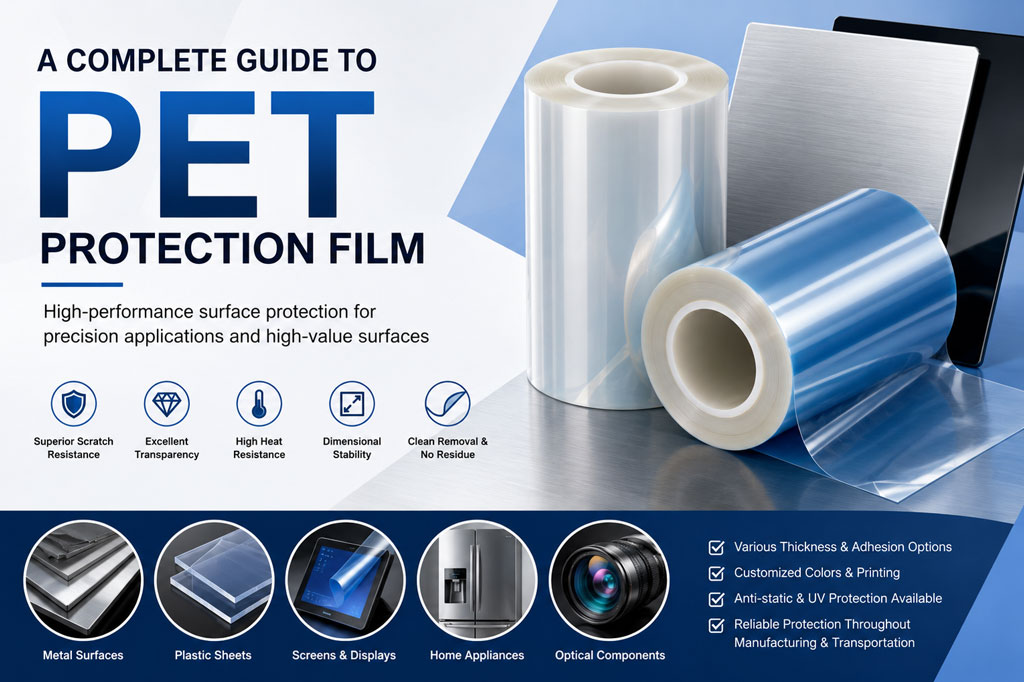
Compared with softer and more flexible PE protective films, PET protective film offers higher tensile strength, lower elongation, better dimensional stability, excellent transparency, and improved resistance to heat and abrasion.
These characteristics make it especially suitable for precision surfaces, electronic displays, polished metals, plastic sheets, optical components, and other applications where surface quality is critical.
This guide explains what PET protection film is, how it works, its structure, key performance parameters, major applications, and how manufacturers can select the right PET protective film for their products.
What Is PET Protection Film?
PET protection film, also known as polyester protective film, is a temporary surface protection material based on polyethylene terephthalate (PET).
A typical PET protective film consists of a PET carrier coated with a pressure-sensitive adhesive (PSA). Depending on the application, additional functional layers can also be incorporated to provide properties such as anti-static performance, UV resistance, or other specialized characteristics.
The film is temporarily laminated onto a finished or semi-finished product to protect its surface during:
- Manufacturing
- Cutting and machining
- Assembly
- Inspection
- Storage
- Transportation
- Installation
After the protected product reaches the appropriate stage, the PET film is removed.
The objective is simple: the film takes the scratches, contamination, abrasion, and handling damage so that the actual product surface does not.
However, PET film distinguishes itself from many general-purpose protective films through its mechanical stability.
Because PET has relatively low elongation and high tensile strength, it is less likely to stretch or deform during application and processing. This makes it particularly useful when manufacturers need precise, stable protection rather than simply flexible coverage.
Structure of PET Protection Film
PET protective film can appear simple, but its performance depends on how several layers work together.
1. PET Film Carrier Layer
The PET carrier provides the main mechanical properties of the protective film.
Compared with PE, PET generally provides:
- Higher tensile strength
- Lower elongation
- Better dimensional stability
- Excellent transparency
- Better scratch and abrasion resistance
- Better heat resistance
- Good chemical resistance
These characteristics are important for precision manufacturing.
For example, when a protective film passes through multiple production stages, excessive stretching can cause wrinkling, displacement, or edge lifting. The dimensional stability of PET helps the film maintain its original shape more consistently.
PET protective films are available in different thicknesses depending on the required protection level and application.
Typical PET protective film thickness can range from approximately 25 to 200 μm, while many industrial surface protection applications use thinner films optimized for the required combination of strength, flexibility, and cost.
2. Pressure-Sensitive Adhesive Layer
The adhesive layer determines how effectively the PET film remains attached to the protected surface.
Acrylic-based pressure-sensitive adhesives are commonly used for PET protective films because they can provide:
- Stable adhesion
- Good aging resistance
- Controlled peel strength
- Clean removal
- Good compatibility with smooth surfaces
- Reliable performance during storage and processing
The correct adhesion level depends heavily on the surface.
For example:
| Surface Condition | Typical Adhesion Requirement |
|---|---|
| Highly polished / very smooth | Low adhesion |
| Smooth metal or plastic | Low to medium adhesion |
| Flat industrial surface | Medium adhesion |
| Slightly textured surface | Medium to high adhesion |
| Rough surface | Higher adhesion |
The key is not to select the strongest adhesive.
Instead, manufacturers should select the minimum adhesion necessary to keep the film securely attached throughout the required process.
Excessive adhesion can increase removal force and potentially create residue or surface-related problems. Insufficient adhesion can result in edge lifting, bubbles, or premature film separation.
3. Optional Functional Layer
PET protection film can also incorporate additional functional properties for specialized applications.
Depending on the end use, these may include:
- Anti-static properties
- UV stabilization
- Scratch-resistant treatment
- Special surface treatments
- Printing
- Customized colors
Anti-static PET protection film, for example, can be particularly useful around electronics and sensitive components where static electricity needs to be controlled.
This ability to combine mechanical protection with functional performance is one reason PET film is widely used for higher-value applications.
How Does PET Protection Film Work?
The basic working principle is straightforward.
- The PET protective film is laminated onto the target surface.
- The pressure-sensitive adhesive establishes temporary contact with the substrate.
- The PET carrier forms a physical barrier over the finished surface.
- Scratches, dust, fingerprints, abrasion, and handling contact affect the film instead of the product.
- After manufacturing, transportation, or installation, the film is peeled away.
But successful protection depends on maintaining a careful balance between three factors:
Protection + Adhesion + Removability
A film can have excellent mechanical strength but still fail if its adhesive does not match the substrate.
Likewise, very strong adhesion does not necessarily mean better protection.
For high-value surfaces, the ideal PET film should remain firmly attached when needed but still peel away smoothly at the end of the protection period.
This is why PET protective film should be considered a surface-specific engineered material rather than a universal adhesive film.
Main Applications of PET Protection Film
PET protective film is particularly useful when dimensional stability, transparency, surface quality, and scratch resistance are important.
1. Metal Surface Protection
PET protective film can be applied to:
- Stainless steel sheets
- Aluminum sheets
- Aluminum profiles
- Brushed metal
- Polished metal
- Decorative metal plates
- Finished metal components
Metal surfaces can pass through cutting, stamping, assembly, inspection, packaging, and transportation before reaching the customer.
A minor scratch created during any of these stages can downgrade an otherwise acceptable product.
PET film provides a stable physical barrier while its high transparency can also allow operators to inspect the underlying surface without removing the protection.
2. Plastic Sheet Protection
PET film is also suitable for protecting plastic surfaces such as:
- Acrylic / PMMA sheets
- Polycarbonate sheets
- PVC panels
- Decorative plastic panels
- High-gloss plastic components
- Plastic display boards
Glossy plastics are particularly vulnerable because even small scratches can become highly visible under reflected light.
PET’s smooth surface, dimensional stability, and abrasion resistance make it useful for maintaining the appearance of these materials throughout fabrication and handling.
3. Screens and Display Panels
Displays represent one of the applications where PET protective film has significant advantages.
Typical applications include:
- LCD panels
- Touch screens
- Appliance control panels
- Electronic displays
- Display windows
- Electronic device housings
These surfaces often require more than basic protection.
The film may need to provide:
- Excellent optical clarity
- Low surface contamination
- Consistent thickness
- Stable dimensions
- Controlled adhesion
- Clean removal
For sensitive electronics, anti-static PET film can also be considered.
4. Optical and Precision Components
PET protection film can also be used for components where surface defects have functional as well as cosmetic consequences.
Examples include:
- Optical sheets
- Lens-related components
- Precision plastic parts
- Decorative films
- High-gloss panels
- Sensitive coated surfaces
In these applications, the value of PET is not simply its strength.
Its predictability is often more important.
Low elongation and good dimensional stability help the protective layer remain consistent during precision processing.
5. Home Appliances and Electronic Products
Modern appliances increasingly use high-gloss, brushed, polished, glass-like, and touch-sensitive surfaces.
PET protective film can protect:
- Refrigerator panels
- Appliance displays
- Touch-control panels
- Decorative trim
- Electronic housings
- High-gloss plastic components
The protection film helps preserve the intended appearance from assembly through final delivery.
Key Performance Parameters of PET Protection Film
Selecting PET protective film based only on thickness is a common mistake.
Several parameters should be evaluated together.
1. Film Thickness
PET protective films can be produced in a broad range of thicknesses.
The appropriate thickness depends on:
- Required mechanical protection
- Surface sensitivity
- Processing conditions
- Application method
- Cost requirements
- End-use environment
Thicker is not automatically better.
Because PET itself has relatively high mechanical strength, a properly selected thinner PET film may already provide sufficient protection for some applications.
The goal should therefore be to find the lowest practical thickness that still meets the required protection performance.
This can help optimize material consumption and overall protection cost.
2. Adhesion Strength
Adhesion is one of the most important parameters.
Depending on the formulation, PET protective film can be designed with different peel strengths.
For example, Changsheng PET protective film solutions cover peel strengths from approximately 0.3 to 8 N, enabling films to be matched to surfaces ranging from smooth substrates to rougher surfaces.
In general:
- Smooth and polished surfaces → lower adhesion
- Standard flat surfaces → low to medium adhesion
- Slightly textured surfaces → medium adhesion
- Rough surfaces → higher adhesion
However, surface roughness is only one factor.
Adhesion should also be evaluated against:
- Surface energy
- Coating chemistry
- Application temperature
- Storage duration
- Environmental exposure
- Removal temperature
- Required service period
For critical applications, sample testing on the actual production surface is strongly recommended.
3. Tensile Strength and Elongation
This is one of the major differences between PET and PE protective films.
PET generally provides: Higher tensile strength + lower elongation
This combination gives PET excellent dimensional stability.
During automated lamination, die-cutting, slitting, handling, or precision processing, the film is less likely to stretch significantly.
This helps reduce:
- Wrinkling
- Misalignment
- Dimensional variation
- Film deformation
- Difficulties during downstream processing
For automated production lines, this consistency can be especially valuable.
4. Heat Resistance
PET generally offers better thermal stability than PE.
This makes PET attractive for applications involving elevated processing temperatures or environments where dimensional changes need to be minimized.
However, manufacturers should not assume that the PET carrier alone determines temperature resistance.
The actual usable temperature range depends on the complete construction, especially:
- PET substrate
- Adhesive formulation
- Coating
- Exposure time
- Surface material
Therefore, heat resistance should always be evaluated as a complete film system, not simply as a property of PET resin.
Surface Finish Options for PET Protective Film
PET protective film does not have to be completely transparent.
Different surface finishes can support different manufacturing requirements.
Transparent PET Protective Film
Transparent film provides excellent visibility of the protected substrate.
It is particularly useful when operators need to inspect:
- Surface quality
- Product color
- Printing
- Alignment
- Assembly conditions
Typical applications include polished metal, glass-like surfaces, displays, and plastic sheets.
Colored PET Protective Film
PET film can be produced in different colors.
Color can help manufacturers:
- Identify different production batches
- Distinguish different product models
- Improve process management
- Provide visual guidance
- Reinforce brand identity
Available options can include blue, white, black, black-and-white, and customized colors.
Matte PET Protective Film
Matte surfaces help reduce glare and reflection.
They can be suitable for applications where visual comfort, controlled reflection, or a particular handling surface is required.
Printed PET Protective Film
Protective film can also become a temporary communication surface.
Customized printing can include:
- Company logos
- Brand colors
- Product information
- Installation instructions
- Handling warnings
- Directional symbols
- QR-related information
Changsheng PET protective film supports customized printing, including up to eight-color printing.
For OEM manufacturers, this means protective film can serve two purposes simultaneously:
surface protection + temporary brand communication
Custom PET Protection Film
Different industries require different protection performance.
A professional PET protective film manufacturer should therefore be able to customize more than just roll dimensions.
Depending on the application, PET protective film can be customized by:
- Film thickness
- Adhesion level
- Roll width
- Roll length
- Sheet dimensions
- Color
- Surface finish
- Printing
- Anti-static properties
- UV resistance
- Functional layers
For OEM applications, custom development becomes especially important when the protected surface has an unusual coating, texture, or processing environment.
The objective should not be to find a “standard PET film” that approximately works.
The better approach is to match the film construction to the surface and production process.
Conclusion
PET protection film combines high tensile strength, low elongation, excellent dimensional stability, optical clarity, abrasion resistance, and controlled adhesion makes it particularly suitable for precision manufacturing and high-value surfaces.
From stainless steel and aluminum to plastic sheets, displays, electronic components, and optical materials, PET protective film helps maintain surface quality throughout manufacturing, storage, transportation, and installation.
Changsheng provides customizable PET protective film solutions with options including different thicknesses, adhesion levels, colors, dimensions, functional properties, and up to eight-color printing. For manufacturers with specific surfaces or processing requirements, testing the film on actual substrate samples can help determine the most appropriate protection solution before mass production.