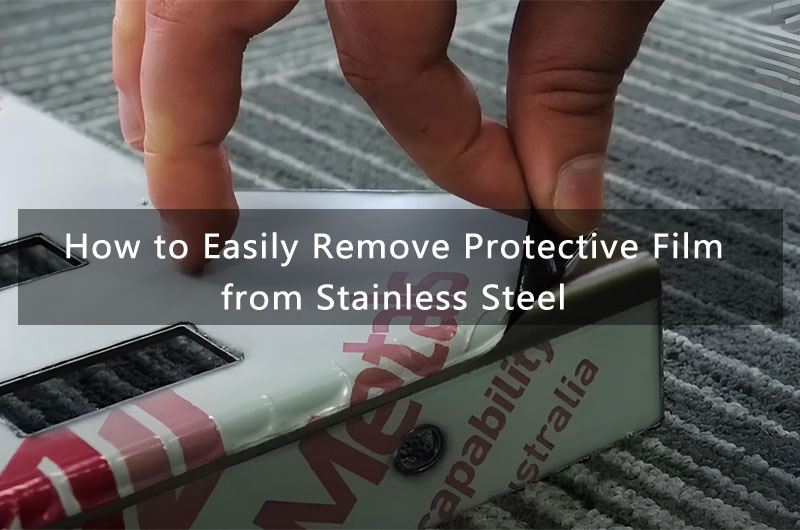
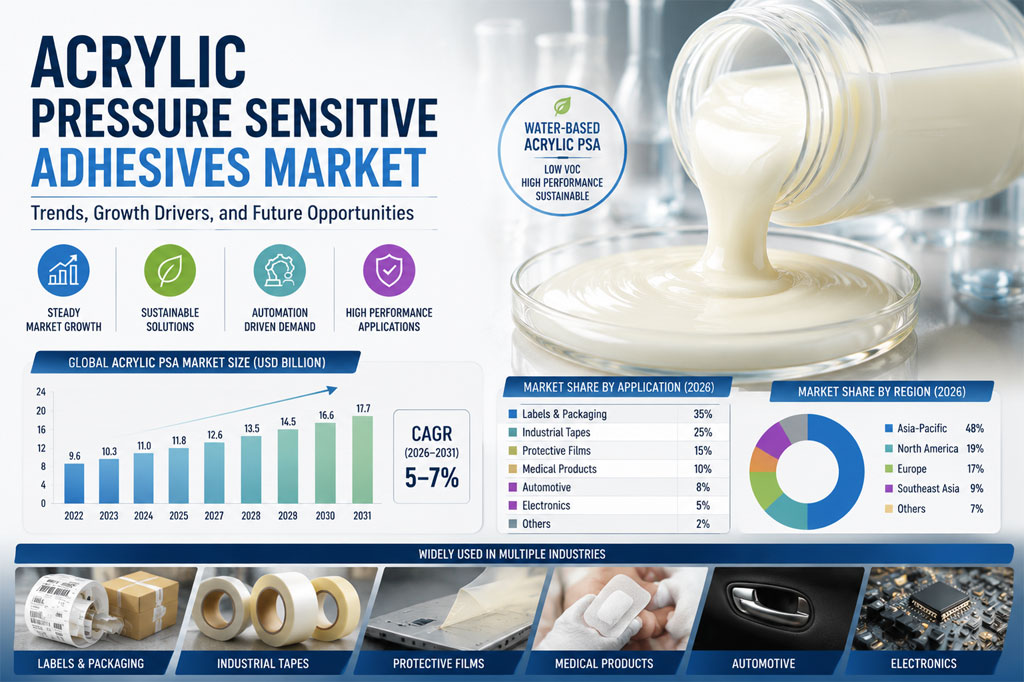
The acrylic pressure sensitive adhesive (PSA) market is undergoing significant transformation.
While demand continues to increase across traditional industries such as labels, tapes, and medical products, the fastest-growing opportunities are emerging in temporary surface protection films, electronics manufacturing, automotive lightweight materials, and sustainable packaging.
Unlike many market reports that focus solely on revenue projections, manufacturers should pay closer attention to where adhesive value is shifting. Future competition will not be determined simply by adhesive strength or price, but by performance in automation, sustainability, and compatibility with new materials.
Global Acrylic PSA Market Snapshot
| Metric | 2026 Estimate |
|---|---|
| Global Market Size | USD 14–16 Billion |
| CAGR (2026–2031) | 5–7% |
| Largest Region | Asia-Pacific |
| Fastest Growing Region | Southeast Asia |
| Fastest Growing Application | Protective Films |
| Main Resin Type | Water-Based Acrylic PSA |
| Sustainability Trend | Low VOC & Solvent-Free |
Estimated Market Distribution by Application
| Application | Market Share |
|---|---|
| Labels & Packaging | 35% |
| Industrial Tapes | 25% |
| Protective Films | 15% |
| Medical Products | 10% |
| Automotive | 8% |
| Electronics | 5% |
| Others | 2% |
Four Major Growth Drivers
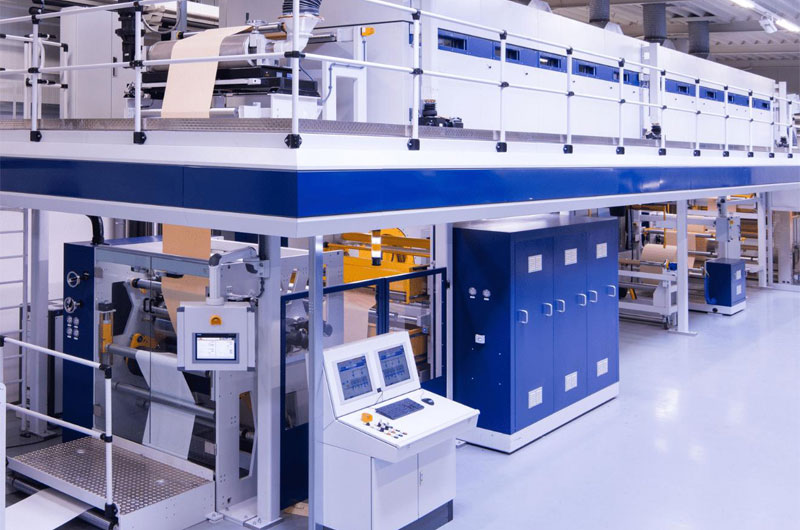
1. Manufacturing Automation Is Increasing Adhesive Consumption
Factories today process products at much higher speeds than they did five years ago.
This creates new adhesive requirements:
- Faster wet-out
- Stable unwind performance
- Bubble-free lamination
- Clean removal
- Consistent peel force
Instead of simply asking for “high adhesion,” manufacturers increasingly request process-friendly adhesives that reduce production downtime.
2. Electronics Industry Requires Ultra-Clean Adhesives
Consumer electronics continue becoming thinner and more expensive.
Applications include:
- Smartphone glass
- Display panels
- Laptop covers
- Aluminum housings
- Touch screens
- Optical films
These products require PSA with:
| Requirement | Importance |
|---|---|
| No residue | ★★★★★ |
| Low VOC | ★★★★★ |
| Low outgassing | ★★★★★ |
| Stable peel force | ★★★★★ |
| Optical clarity | ★★★★☆ |
Even slight adhesive residue can reduce production yield.
3. Protective Film Has Become One of the Fastest Growing Markets
Many people think the protective film business is mature.
In reality, the adhesive requirements are becoming more demanding every year.
Modern protective films must protect surfaces through:
- Laser cutting
- CNC machining
- Bending
- Stamping
- Transportation
- Storage
- Installation
One adhesive often cannot satisfy every stage.
As a result, manufacturers increasingly develop application-specific PSA formulations rather than universal products.
This is creating opportunities for customized acrylic PSA manufacturers.
4. Sustainability Is Reshaping the Industry
Environmental regulations are changing adhesive technology worldwide.
Major trends include:
- Water-based systems
- Solvent-free production
- Low VOC emissions
- Recyclable protective films
- Renewable raw materials
Many multinational OEMs now require suppliers to disclose:
- VOC content
- Carbon footprint
- REACH compliance
- RoHS compliance
- PFAS status
Sustainability is becoming a purchasing requirement instead of a marketing slogan.
Regional Market Analysis
| Region | Market Characteristics |
|---|---|
| Asia-Pacific | Largest manufacturing base, strongest demand |
| Europe | Sustainability-driven, premium products |
| North America | High-performance industrial PSA |
| Southeast Asia | Fastest capacity expansion |
| Middle East | Growing packaging demand |
| South America | Emerging industrial market |
Asia-Pacific will remain the world’s largest production center because of continued investment in:
- Electronics
- Automotive
- Metal processing
- Building materials
- Home appliances
Emerging Opportunities
Surface Protection for Laser Cutting
Fiber laser cutting has dramatically increased processing speeds.
This creates new adhesive challenges:
| Traditional Requirement | New Requirement |
|---|---|
| Strong adhesion | Stable adhesion during heating |
| Easy removal | No edge lifting |
| Good appearance | Anti-burn performance |
| Low residue | Laser compatible |
The adhesive is no longer merely a bonding material—it has become an integral part of the manufacturing process.
EV Battery Manufacturing
Electric vehicle batteries require protection during:
- Cell production
- Module assembly
- Busbar processing
- Aluminum housing fabrication
These applications require PSA that can withstand:
- Heat
- Solvents
- Humidity
- Mechanical processing
Demand from EV manufacturing is expected to continue growing.
Renewable Energy
Protective films are increasingly used for:
- Solar module frames
- Aluminum profiles
- PV glass
- Energy storage systems
These industries require adhesives with excellent outdoor durability and UV resistance.
Technology Trends
Water-Based Acrylic PSA
Advantages
- Low VOC
- Easy coating
- Excellent weather resistance
- Lower environmental impact
UV Acrylic PSA
Advantages
- Fast curing
- High production efficiency
- Low energy consumption
High-Performance Crosslinked PSA
Features
- Better heat resistance
- Higher shear strength
- Improved dimensional stability
Smart Functional PSA
Future developments include:
- Conductive PSA
- Anti-static PSA
- Optical PSA
- Heat-resistant PSA
- Removable high-performance PSA
These specialty adhesives command higher margins than commodity formulations.
Market Challenges
Despite continued growth, manufacturers face several challenges.
| Challenge | Industry Impact |
|---|---|
| Raw material volatility | Rising production costs |
| Environmental regulations | Reformulation expenses |
| Low-price competition | Margin pressure |
| Customer customization | Increased R&D investment |
| Automation requirements | Higher quality standards |
Strategic Insight: The Next Competitive Battlefield
Most market reports emphasize market size.
The more important question is:
Where will profit growth come from?
The answer is specialization, not commoditization.
Manufacturers focusing solely on general-purpose acrylic PSA are likely to face increasing price competition. In contrast, companies developing adhesives tailored for specific industrial processes can create stronger customer relationships and improve margins.
High-growth niches include:
| High-Value Segment | Growth Potential |
|---|---|
| Laser Cutting Protective Film | ★★★★★ |
| Electronics Protection Film | ★★★★★ |
| Automotive Interior Film | ★★★★☆ |
| Medical Protective Film | ★★★★☆ |
| Optical Film | ★★★★☆ |
| Building Materials | ★★★☆☆ |
The greatest opportunity lies in application engineering—understanding how the adhesive performs within the customer’s manufacturing process, rather than optimizing only laboratory specifications.
Future Outlook
Over the next five years, the acrylic PSA market will be driven less by overall demand growth and more by advances in manufacturing technology and sustainability expectations. Success will depend on delivering adhesives that are:
- Environmentally compliant
- Consistent in automated production
- Compatible with advanced materials
- Customizable for industry-specific needs
- Backed by technical support and application expertise
Manufacturers that combine material innovation with process knowledge will be better positioned to capture premium opportunities in protective films, electronics, EVs, and renewable energy, rather than competing primarily on price.