When selecting aluminum profile protective films, buyers often focus on obvious parameters such as film thickness, adhesive strength, color, and UV resistance. However, one factor is frequently underestimated: the surface roughness of the aluminum profile itself.
Two aluminum profiles made from the same alloy can require completely different protective films simply because their surface finishes create different microscopic topographies.
A film that adheres perfectly to a smooth anodized profile may develop edge lifting or bubbles on a textured powder-coated profile. Conversely, using a stronger adhesive to solve this problem can create excessive peel force or adhesive residue.
Understanding how surface roughness changes the actual contact between the adhesive and aluminum surface is therefore essential for choosing the right protective film.
1. Surface Roughness Changes the Real Contact Area
An aluminum profile may look flat to the naked eye, but under magnification its surface contains microscopic peaks and valleys.
This difference is critical for pressure-sensitive adhesives.
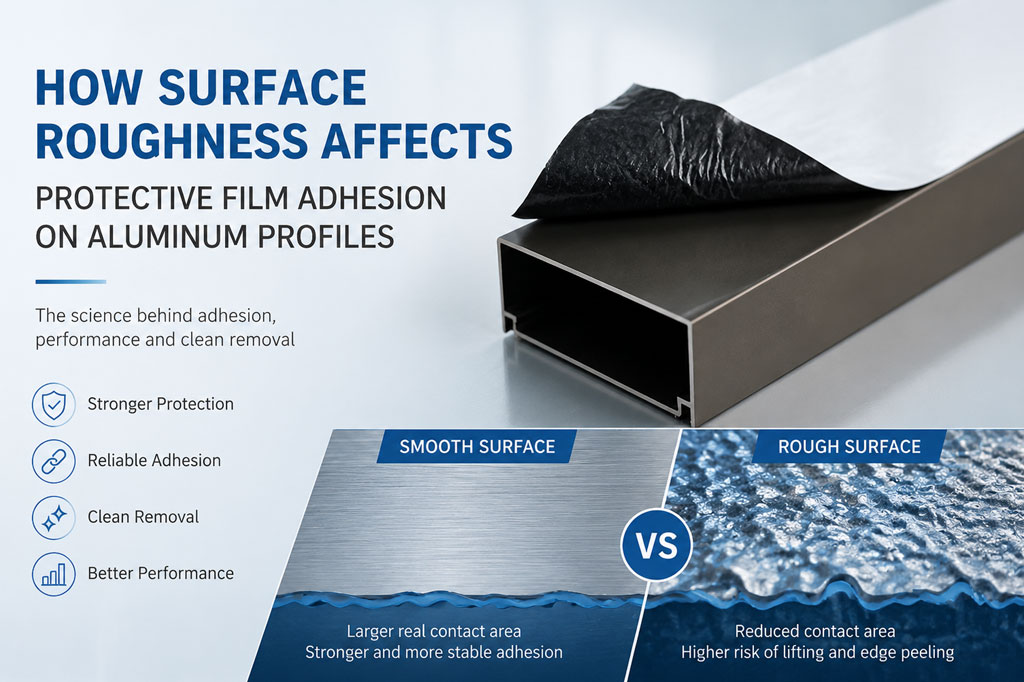
When protective film is laminated onto a relatively smooth surface, the adhesive can establish close contact across a large proportion of the apparent surface area.
On a rough surface, however, the adhesive initially contacts mainly the higher points of the surface texture. Some valleys may remain partially unfilled.
In other words:
Apparent contact area ≠ actual adhesive contact area.
As surface roughness increases, the gap between these two values can become increasingly important.
This explains a common phenomenon in aluminum profile production:
The same protective film can show very different peel strength on two profiles even when the aluminum alloy, film and lamination conditions are identical.
The surface finish has changed the adhesive interface.
2. Why Rough Aluminum Surfaces Often Need Different Adhesive Behavior
It is tempting to conclude that rougher surfaces simply require stronger adhesive.
In practice, the situation is more complicated.
For a pressure-sensitive adhesive to bond effectively, it must be able to wet the microscopic surface structure.
Consider two simplified surfaces:
Smooth Surface
A relatively smooth anodized or polished aluminum surface allows the adhesive layer to spread and establish intimate contact relatively easily.
The result is generally:
- Larger effective contact area
- More uniform adhesion
- Lower risk of localized lifting
- More predictable peel strength
Because contact efficiency is already high, an unnecessarily aggressive adhesive may actually create problems during removal.
Rough or Textured Surface
Powder-coated, sand-textured or certain decorative aluminum profiles may have much more pronounced microscopic peaks and valleys.
If the adhesive cannot conform sufficiently to this structure, contact becomes discontinuous.
Possible consequences include:
- Lower effective adhesion
- Air pockets
- Edge lifting
- Film detachment during bending or fabrication
- Reduced protection during transportation
- Uneven peel performance
Therefore, protective film for rough aluminum surfaces needs not only suitable nominal adhesion but also appropriate adhesive flow, coating weight and conformability.
3. Adhesive Strength Alone Does Not Solve Roughness Problems
This is one of the most important distinctions when selecting protective film.
Suppose a film repeatedly lifts from a textured aluminum profile. A simple response would be:
“Increase the adhesive strength.”
Sometimes this works—but sometimes it creates a new problem.
A higher-tack adhesive may improve anchoring at the surface peaks while still failing to fully penetrate microscopic valleys. Meanwhile, the stronger adhesive can make the film difficult to remove after storage or processing.
This may increase the risk of:
- Adhesive transfer
- Excessive peel force
- Surface contamination
- Coating damage
- Difficult manual removal
A better approach is to consider the adhesive system as a whole.
For rough surfaces, an adhesive with suitable softness and wetting characteristics can sometimes outperform a nominally stronger but harder adhesive.
This leads to an important protective-film principle:
Good adhesion is not simply the result of stronger glue. It is the result of maximizing controlled interfacial contact.
4. How Different Aluminum Surface Finishes Affect Protective Film Adhesion
Different finishing processes create very different surface conditions.
| Aluminum Surface | Typical Surface Character | Adhesion Behavior | Protective Film Consideration |
|---|---|---|---|
| Polished Aluminum | Very smooth | High contact efficiency | Low to medium adhesion may be sufficient |
| Anodized Aluminum | Smooth to moderately textured | Generally stable | Select according to anodizing texture |
| Electrophoretic Coating | Relatively smooth and uniform | Good adhesive contact | Avoid unnecessarily aggressive adhesive |
| Powder Coating | Smooth to heavily textured | Highly variable | Adhesive must match coating texture |
| Wood-Grain Finish | Patterned / textured | Uneven contact possible | Good conformability is important |
| Brushed Aluminum | Directional micro-grooves | Contact varies with texture | Testing is recommended |
| Sandblasted Surface | Relatively rough | Reduced real contact area | Higher wetting/conformability may be required |
The key point is that labels such as “powder-coated aluminum” are not precise enough for protective film selection.
One powder coating may be nearly smooth, while another has a pronounced orange-peel or sand-textured finish.
Their protective film requirements can be completely different.
5. Ra Value Is Useful—but It Does Not Tell the Whole Story
Surface roughness is commonly described using Ra, the arithmetic average roughness.
Ra provides useful quantitative information, but protective-film performance should not be predicted from Ra alone.
Imagine two aluminum surfaces with similar average roughness.
Surface A may contain many small, closely spaced peaks.
Surface B may contain fewer but deeper valleys and sharper peaks.
Their Ra values could be similar, yet an adhesive may behave differently on each surface.
Other characteristics can also matter, including:
- Peak height
- Valley depth
- Peak spacing
- Texture direction
- Surface porosity
- Coating chemistry
- Surface energy
This is why laboratory peel testing on the customer’s actual aluminum profile is much more reliable than selecting film purely from a roughness specification.
6. Roughness and Surface Energy Should Be Considered Together
Another common mistake is treating surface roughness as an isolated variable.
Adhesion depends on both physical topography and surface chemistry.
For example, two powder-coated aluminum profiles may have similar roughness but different coating formulations. Their surface energies may differ, changing how easily the acrylic pressure-sensitive adhesive wets the surface.
Therefore, protective film adhesion can be viewed as the interaction of three major factors:
Surface Topography × Surface Energy × Adhesive Rheology
Ignoring any one of these factors can lead to incorrect film selection.
This also explains why a protective film that performs well on one customer’s powder-coated profile cannot automatically be assumed to work on another customer’s apparently similar product.
7. Protective Film Thickness Also Influences Performance on Rough Profiles
Adhesive selection receives most of the attention, but the PE film itself also matters.
A very thin or relatively stiff film may have difficulty following pronounced surface geometry, particularly around:
- Profile corners
- Grooves
- Embossed areas
- Curved sections
- Deep decorative textures
A film with appropriate flexibility can maintain better contact as the aluminum profile moves through fabrication, packaging and transportation.
For demanding applications, therefore, the optimum solution is a combination of:
Film thickness + film flexibility + adhesive coating + adhesive strength.
Changing only one parameter may not solve the underlying problem.
8. Surface Roughness Should Be Part of Protective Film Customization
For protective film manufacturers, surface roughness should not be treated merely as a problem to overcome. It should be treated as an input parameter for adhesive design.
A smooth electrophoretic aluminum profile may require a relatively low-tack adhesive system to prevent excessive adhesion.
A moderately textured powder-coated profile may require better wetting and somewhat higher adhesion.
A heavily textured architectural profile may require optimization of adhesive coating weight, rheology and film conformability simultaneously.
This is where customized protective film becomes valuable.
Instead of offering only fixed categories such as low, medium and high adhesion, a manufacturer can match the protective film to the customer’s actual surface and downstream process.
Conclusion
Surface roughness has a direct but often misunderstood influence on protective film adhesion on aluminum profiles.
Rougher surfaces generally reduce the effective contact area between the pressure-sensitive adhesive and the substrate. However, simply increasing adhesive strength is not always the best solution.
Reliable protection depends on balancing:
surface roughness, surface energy, adhesive wetting, adhesive rheology, coating weight, film flexibility and final removability.
For aluminum profile manufacturers, the most reliable protective film is therefore not necessarily the one with the highest peel strength. It is the film whose adhesive system creates sufficient and stable contact with the specific aluminum surface while still allowing clean removal after manufacturing, transportation and installation.
That distinction turns protective film selection from a simple “tack level” decision into an engineered surface-matching process.