Aluminum profiles are widely used in windows and doors, curtain walls, furniture, industrial equipment, transportation, and architectural decoration. However, the aluminum surface often goes through cutting, CNC machining, assembly, transportation, storage, and installation before the finished product reaches the customer.
A temporary protective film for aluminum profiles helps prevent scratches, abrasion, fingerprints, dust, stains, and other surface damage during these processes.
However, not every aluminum profile should use the same protective film.
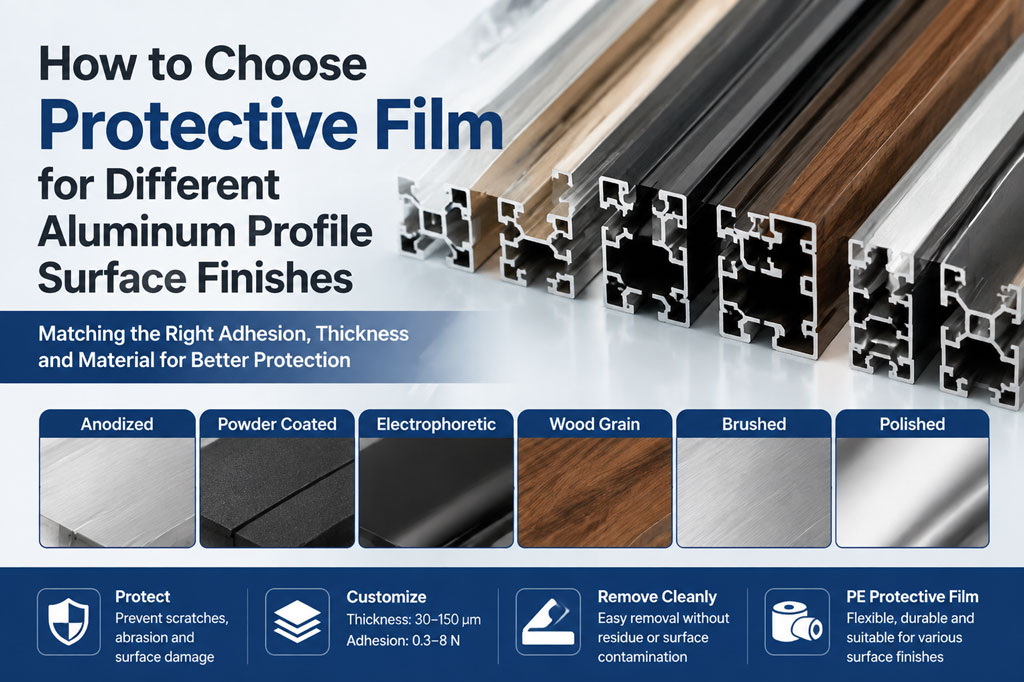
An anodized aluminum profile, for example, has very different surface characteristics from a brushed, powder-coated, electrophoretic, wood-grain, or polished profile. Surface roughness, coating chemistry, gloss level, and processing conditions all influence how well a protective film adheres and how easily it can be removed.
This guide explains how to match protective film to different aluminum profile surface finishes.
Why Aluminum Surface Finish Matters When Choosing Protective Film
One of the most common mistakes is selecting protective film based only on aluminum profile dimensions or the required protection period.
In practice, the surface finish is one of the most important factors determining adhesion.
Consider two opposite situations.
A smooth, high-gloss aluminum surface provides a large and consistent contact area between the pressure-sensitive adhesive and the substrate. Excessive adhesion may therefore make the film difficult to remove or increase the risk of adhesive transfer.
A rough or textured surface has microscopic peaks and valleys. The adhesive cannot contact the entire surface uniformly. If adhesion is too low, the protective film may lift around the edges or fall off during fabrication and transportation.
A useful general principle is:
Smoother aluminum surfaces generally require lower adhesion, while rougher or textured surfaces generally require higher adhesion.
Film thickness should then be selected according to the mechanical protection required during downstream processing.
Protective Film Selection by Aluminum Surface Finish
| Aluminum Surface Finish | Surface Characteristics | Suggested Adhesion | Typical Film Thickness |
|---|---|---|---|
| Anodized | Smooth, decorative oxide layer | Low–Medium | Around 60 μm |
| Powder Coated | Smooth to textured | Medium–High | 70–140 μm |
| Electrophoretic Coated | Very smooth, uniform coating | Low | Around 60 μm |
| Wood Grain | Printed/textured decorative finish | Medium–High | 70–140 μm |
| Brushed | Directional surface texture | High | Around 140 μm |
| Polished / High Gloss | Very smooth and reflective | Low–Medium | 50–100 μm |
| Fluorocarbon Coated | Smooth coated architectural surface | Medium | Around 70 μm |
These values should be treated as a starting point rather than a universal specification. Actual adhesion should be verified on the customer’s aluminum profile because coating formulation, surface roughness, temperature, application pressure, storage time, and outdoor exposure can all affect film performance.
1. Anodized Aluminum Profiles
Anodizing creates a controlled oxide layer on the aluminum surface, improving corrosion resistance while also providing a decorative appearance. Anodized profiles are commonly used for architectural frames, doors, windows, furniture, and industrial components.
Although the anodized layer is relatively durable, visible scratches can still significantly reduce the appearance of the finished product.
For anodized profiles, the protective film should provide sufficient adhesion without becoming unnecessarily aggressive.
A typical solution can use:
- Material: PE protective film
- Thickness: Around 60 μm
- Adhesion: Low to medium
- Reference peel strength: Approximately 2–3 N
The main objective is not maximum adhesion. It is stable adhesion throughout processing combined with clean removal at the end of the protection period.
For this reason, buyers should test not only initial peel strength but also peel performance after storage or temperature exposure.
2. Powder-Coated Aluminum Profiles
Powder coating is widely used for architectural aluminum profiles because it provides excellent decorative flexibility, weather resistance, and corrosion protection.
The challenge for protective film manufacturers is that powder-coated aluminum does not represent one standardized surface.
Depending on the powder formulation and coating process, the finished surface can be:
- High gloss
- Semi-gloss
- Matte
- Fine textured
- Coarse textured
This means protective film adhesion requirements can vary significantly.
A smooth powder-coated surface may only require medium adhesion, while a textured coating can require considerably stronger adhesion to prevent lifting.
For rougher electrostatic-coated aluminum surfaces, thicker PE film—potentially around 140 μm—combined with higher adhesion can provide better mechanical protection and surface conformity.
When selecting film for powder-coated profiles, we recommend sending actual profile samples to the protective film manufacturer rather than selecting the film based only on the description “powder coated.”
Surface texture matters as much as the coating type.
3. Electrophoretic Coated Aluminum Profiles
Electrophoretic coating creates a relatively smooth and uniform surface and is frequently used where both appearance and corrosion resistance are important.
Because the surface can be very smooth, excessive adhesive strength is usually unnecessary.
For example, a typical electrophoretic aluminum profile solution may use:
- PE film
- Around 60 μm thickness
- Low adhesion
- Approximately 0.3–0.5 N peel strength
This is substantially lower than the adhesion that may be required for brushed or rough coated aluminum.
This difference illustrates why purchasing one “universal aluminum protective film” for every production line can create problems.
A high-adhesion film suitable for a rough profile may be unnecessarily aggressive on an electrophoretic surface.
4. Wood-Grain Aluminum Profiles
Wood-grain aluminum profiles combine the durability of aluminum with decorative patterns that simulate natural wood. They are increasingly used for doors, windows, façade elements, pergolas, furniture, and architectural decoration.
Protecting these profiles presents two challenges.
First, the decorative surface itself must remain visually intact. Scratches or abrasion can interrupt the printed wood pattern and become highly noticeable.
Second, some wood-grain finishes have subtle surface texture. This reduces effective adhesive contact compared with a completely flat aluminum surface.
Therefore, protective film for wood-grain aluminum usually needs a balance of:
Good conformability + sufficient adhesion + clean removability.
For relatively textured wood-grain finishes, medium-to-high adhesion may be required. A thicker PE film can also provide additional resistance against abrasion during stacking, transportation, cutting, and installation.
However, because wood-grain coatings and transfer processes vary between manufacturers, actual sample testing is particularly important.
5. Brushed Aluminum Profiles
Brushed aluminum has fine directional lines created through mechanical surface finishing. It provides a distinctive metallic appearance but is also particularly sensitive to scratches.
Scratches running across the brushing direction can be highly visible.
Brushed surfaces can also be more difficult for protective film adhesion because their microscopic surface texture reduces uniform adhesive contact.
For this reason, brushed aluminum may require a stronger protective film.
A typical configuration can reach:
- Thickness: Around 140 μm
- Adhesion: High
- Reference peel strength: Approximately 6–8 N
The thicker film improves resistance to mechanical damage, while higher adhesion helps keep the film attached to the textured surface.
This makes brushed aluminum a good example of why higher surface roughness often requires higher protective-film adhesion.
6. Polished and High-Gloss Aluminum Profiles
Polished aluminum creates the opposite challenge.
The surface is smooth, reflective, and highly sensitive to even minor defects. Fine scratches, fingerprints, pressure marks, or adhesive residue may be immediately visible.
Therefore, the protective film should adhere uniformly without being excessively aggressive.
Low-to-medium adhesion is generally preferable, depending on the exact polishing process and required protection period.
The PE film should also have:
- Uniform thickness
- Stable adhesive coating
- Good surface cleanliness
- Easy peeling performance
- Low risk of adhesive transfer
For mirror-like or highly polished aluminum, cleanliness during film application becomes especially important. Dust trapped between the film and aluminum can itself create pressure points or scratches during subsequent handling.
7. Fluorocarbon-Coated Aluminum Profiles
Fluorocarbon coatings are commonly found on architectural aluminum components requiring strong weather resistance and long service life.
These profiles may undergo considerable handling during fabrication, transportation, and façade installation.
A typical protective-film configuration can use approximately:
- 70 μm PE film
- Medium adhesion
- 3–4 N peel strength
If profiles or panels will remain outdoors before installation, UV resistance becomes another important consideration.
The protective film should be selected according to the expected outdoor exposure period rather than simply using a standard indoor film for a longer time.
Conclusion
Choosing protective film for aluminum profiles is ultimately a surface-matching problem, not simply a film-purchasing decision.
Smooth electrophoretic or polished surfaces generally need lower adhesion. Anodized profiles may require low-to-medium adhesion. Powder-coated surfaces need to be evaluated according to their texture. Brushed and heavily textured surfaces typically require higher adhesion and may benefit from thicker films.
The best protective film is therefore not the one with the highest peel strength or greatest thickness.
It is the film that provides enough adhesion to remain stable throughout manufacturing and logistics, enough mechanical strength to protect the aluminum surface, and clean removability when the protection is no longer needed.