Choosing protective film for a standard smooth aluminum profile is relatively straightforward. But what happens when the aluminum surface is textured, unusually rough, highly glossy, newly powder-coated, or treated with a proprietary finish?
In these situations, selecting a protective film from a standard specification sheet is often not enough.
The same adhesive can behave very differently on anodized aluminum, powder-coated aluminum, electrophoretic coatings, wood-grain finishes, brushed surfaces, and polished aluminum. Even two powder-coated profiles can require different protective films because their coating chemistry, surface roughness, gloss level, and curing conditions are different.
That is why, at Changsheng, we approach custom aluminum profile protective film development as a surface-matching process rather than simply a film-selection process.
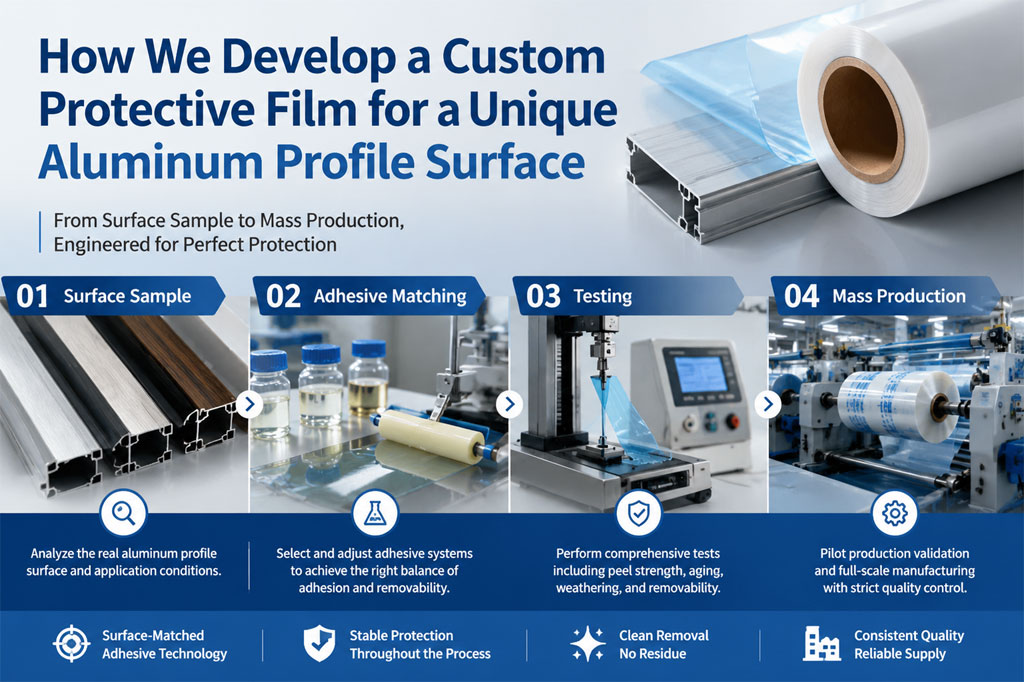
Our typical development workflow consists of four major stages:
Surface Sample → Adhesive Matching → Testing → Mass Production
1. Start with the Actual Aluminum Profile Surface
The first and most important step is obtaining an actual surface sample.
Customers sometimes provide basic information such as:
- Anodized aluminum
- Powder-coated aluminum
- Electrophoretic aluminum
- Wood-grain aluminum
- Brushed aluminum
- Polished aluminum
This information is useful, but it is usually not enough to determine the correct protective film.
Why Do We Need an Actual Sample?
Protective film adhesion is strongly influenced by the microscopic condition of the surface.
For example, two black powder-coated aluminum profiles may look almost identical to the eye but have different:
- Surface roughness
- Coating formulations
- Gloss levels
- Surface energy
- Texture depth
- Curing conditions
- Residual processing chemicals
These differences can significantly affect how the pressure-sensitive adhesive interacts with the profile.
A smooth, high-gloss coating may provide a large contact area between the adhesive and the surface. A heavily textured powder coating, however, reduces the effective contact area.
As a result, a protective film that works perfectly on the first surface may have insufficient adhesion on the second.
For custom projects, we therefore prefer customers to send us representative aluminum profile samples with the actual production surface finish.
What We Evaluate
After receiving the sample, our technical team evaluates several characteristics.
| Surface Factor | Why It Matters |
|---|---|
| Surface roughness | Influences the effective adhesive contact area |
| Gloss level | Often indicates differences in coating texture |
| Surface texture | Deep textures may require higher conformability or adhesion |
| Coating type | Different coatings interact differently with PSA |
| Surface cleanliness | Oil, dust, release agents, and residues can affect adhesion |
| Profile geometry | Corners, grooves, curves, and edges influence film application |
| Intended processing | Cutting, bending, punching, transportation, or installation may require different performance |
The objective is simple: understand the surface before choosing the adhesive.
2. Match the Adhesive to the Surface
Once we understand the aluminum profile surface, the next stage is adhesive matching.
This is usually the most important part of custom protective film development.
Protective film adhesion should not simply be classified as “low,” “medium,” or “high.” What matters is whether the adhesive creates the right balance between initial adhesion, holding power, process stability, and clean removability.
Too Little Adhesion Creates Problems
If adhesion is too low, the film may:
- Lift from profile edges
- Bubble during processing
- Peel during transportation
- Detach when profiles are cut
- Lose protection during installation
The problem becomes especially noticeable on textured or rough powder-coated surfaces.
Too Much Adhesion Also Creates Problems
Increasing adhesion is not always the solution.
Excessive adhesion may result in:
- Difficult peeling
- Adhesive transfer
- Increased peel force after aging
- Surface contamination
- Damage to sensitive coatings
The correct protective film therefore needs a controlled adhesion window.
Developing Candidate Adhesive Formulations
Based on the surface analysis and application requirements, we select several candidate adhesive systems rather than immediately committing to one formulation.
For example:
| Aluminum Surface | Typical Development Focus |
|---|---|
| Smooth anodized | Low-to-medium controlled adhesion |
| Rough anodized | Improved surface contact |
| High-gloss powder coating | Stable adhesion with clean removal |
| Textured powder coating | Higher wetting and conformability |
| Electrophoretic coating | Surface compatibility and residue control |
| Wood-grain finish | Balanced adhesion without damaging decorative layers |
| Polished aluminum | Very clean removal and surface appearance protection |
At Changsheng, our protective films use pressure-sensitive adhesive systems that can be adjusted according to the customer’s actual surface.
This ability to modify the adhesive is particularly important for unusual aluminum finishes where standard market products may not perform consistently.
3. Test More Than Initial Peel Strength
One of the most common mistakes in protective film selection is evaluating the film immediately after application and assuming that good initial adhesion means the film is suitable.
In real applications, the protective film may remain on the aluminum profile for weeks or months.
During that period, it may experience:
coating → storage → fabrication → transportation → outdoor exposure → installation → removal
The adhesive must remain stable throughout this entire cycle.
Therefore, our testing focuses on how adhesion changes over time, not only how the film performs immediately after application.
Initial Adhesion Testing
Candidate films are first laminated onto the customer’s aluminum sample under controlled conditions.
We evaluate:
- Film wetting
- Edge adhesion
- Bubble formation
- Conformability
- Initial peel behavior
Several adhesive formulations may be compared side by side.
Peel Force Testing
Peel strength is measured to determine whether the film falls within an appropriate adhesion range.
However, we do not automatically select the sample with the highest peel force.
The target is a film that is strong enough to stay attached but easy enough to remove cleanly.
Aging Testing
This step is especially important.
Pressure-sensitive adhesive behavior can change after prolonged contact with coated surfaces. Temperature can accelerate these changes.
Depending on the customer’s application, samples may therefore undergo controlled aging tests.
After aging, we examine:
- Changes in peel strength
- Adhesive transfer
- Surface staining
- Ghost marks
- Coating interaction
- Removal difficulty
A film that performs well initially but becomes difficult to remove after aging is not considered a successful match.
4. Simulate the Customer’s Real Processing Conditions
Laboratory adhesion testing alone cannot reproduce every production environment.
For aluminum profiles, we therefore try to understand what happens to the film after it is applied.
Will the profile be:
- Saw cut?
- CNC machined?
- Drilled?
- Bent?
- Stamped?
- Packed tightly together?
- Exported in containers?
- Stored outdoors?
- Installed several months later?
These details influence protective film design.
Example: Profile Cutting
If a film is used during aluminum profile cutting, it needs sufficient adhesion around the cutting area.
Otherwise, vibration and mechanical forces may cause the film to lift.
Example: Long-Distance Export
A profile shipped internationally may experience high container temperatures and long storage periods.
In this situation, adhesive aging stability can be more important than very high initial tack.
Example: Outdoor Construction
For aluminum profiles used in windows, curtain walls, doors, or façade systems, the protective film may remain attached during installation.
UV exposure and weather resistance may therefore become part of the specification.
This is why we ask customers about the complete application process, rather than only asking, “What adhesion do you need?”
5. Confirm the Film Structure and Other Specifications
Once the adhesive system has been identified, we optimize the remaining protective film specifications.
These may include:
Film Thickness
Different applications require different mechanical protection.
A thicker PE film can provide greater resistance against scratches, abrasion, and handling damage, while lighter applications may benefit from a thinner, more economical structure.
Film Width
The film can be slit according to the dimensions of the aluminum profile.
Matching the film width helps improve application efficiency and reduces unnecessary material consumption.
Color
Common options include:
- Transparent
- Blue
- Black and white
- Milky white
- Other customized colors
Color can also help manufacturers distinguish different product grades, production lines, or customers.
Printing
Protective film can become more than temporary packaging.
Custom printing can include:
- Company logo
- Brand name
- Product information
- Installation instructions
- Removal instructions
- Warning messages
For aluminum profile manufacturers, this turns the protective film into a temporary branding and communication surface throughout the supply chain.
6. Pilot Production Before Full Mass Production
Moving directly from a laboratory sample to a large commercial order introduces unnecessary risk.
For unique surfaces, we recommend an intermediate pilot production stage.
A small batch of protective film is manufactured according to the selected formulation and specifications.
The customer can then apply the film on the actual production line.
This is valuable because industrial laminating conditions may differ from laboratory conditions.
Production-line factors can include:
- Laminating pressure
- Laminating speed
- Profile temperature
- Surface cleanliness
- Film tension
- Equipment configuration
The customer can also run the protected profiles through their normal cutting, packing, storage, and transportation processes.
This gives us a much more realistic indication of performance.
7. Finalize the Specification and Move to Mass Production
Once the pilot film has been validated, the final specification is confirmed.
A typical customized protective film specification may include:
| Parameter | Customization |
|---|---|
| Base film | PE protective film |
| Thickness | Customized according to application |
| Adhesion | Matched to actual aluminum surface |
| Width | Customized |
| Length | Customized |
| Color | Transparent, blue, black/white, etc. |
| Printing | Logo, instructions, warnings |
| UV resistance | Available according to application |
| Application | Anodized, powder-coated, electrophoretic, polished, wood-grain aluminum, etc. |
The approved parameters then become the reference for mass production and quality control.
For repeat orders, maintaining consistency becomes particularly important. Adhesion, film thickness, appearance, winding quality, and other key characteristics must remain within the agreed specification.
Custom Protective Film Development Is Really Surface Engineering
A protective film may look like a simple combination of PE film + pressure-sensitive adhesive, but successful aluminum profile protection depends heavily on the interaction between the adhesive and the surface underneath it.
This is particularly true as aluminum manufacturers introduce increasingly diverse finishes—from fine-textured architectural powder coatings to high-gloss decorative surfaces and realistic wood-grain treatments.
Instead of asking:
“Which protective film has the strongest adhesive?”
A better question is:
“Which adhesive system creates the most stable interface with this specific aluminum surface throughout its entire processing and storage cycle?”
That shift in thinking is the foundation of our custom development process.
From Your Aluminum Sample to a Production-Ready Protective Film
At Changsheng, we don’t expect customers with unusual aluminum surfaces to select a protective film based only on a catalog specification.
Our development process follows a practical path:
1. Send the actual aluminum profile sample
↓
2. Analyze the surface and application conditions
↓
3. Select and adjust candidate adhesive systems
↓
4. Conduct adhesion, aging, and removal tests
↓
5. Produce pilot samples for production-line validation
↓
6. Confirm thickness, adhesion, size, color, and printing
↓
7. Move to controlled mass production
For aluminum profile manufacturers, this approach reduces the risk of discovering adhesion problems after thousands of meters of film have already been applied.
The goal is not simply to manufacture a custom protective film.
It is to develop a protective film specifically matched to the customer’s aluminum surface, manufacturing process, storage conditions, and removal requirements.