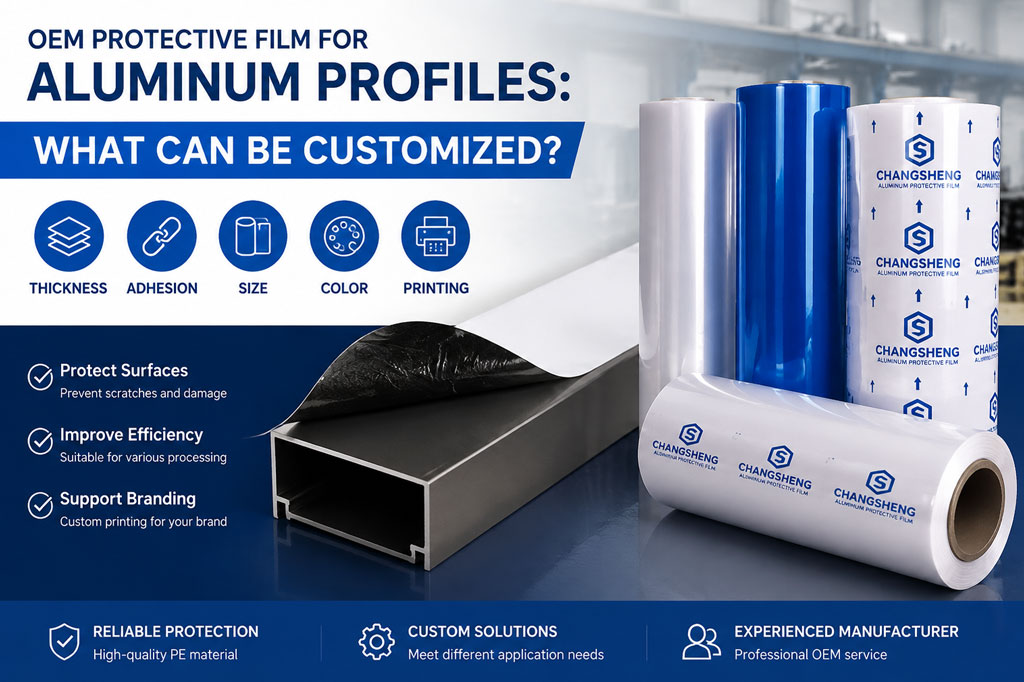
For aluminum profile manufacturers and processors, five of the most important customizable parameters are thickness, adhesion, size, color, and printing.
1. Protective Film Thickness
Thickness is one of the first specifications considered when customizing protective film for aluminum profiles.
The required thickness of protective films depends heavily on what happens to the profile after the film is applied.
A relatively light-duty profile that only needs protection against dust and minor handling may not require the same film as an aluminum component that will undergo cutting, machining, fabrication, stacking, and long-distance transportation.
How Thickness Affects Protection
Increasing film thickness can generally provide better resistance to:
- Scratching
- Puncture
- Tearing
- Friction during stacking
- Handling damage
- Mechanical stress during fabrication
However, thicker does not automatically mean better.
Excessive thickness increases material consumption and cost and may provide little additional value for low-risk applications. The objective of OEM customization should therefore be to find the minimum practical thickness that reliably survives the customer’s manufacturing and logistics process.
| Application Condition | Typical Protection Requirement | Thickness Strategy |
|---|---|---|
| Indoor handling | Light | Thin/light-duty film |
| General fabrication | Medium | Standard film |
| Cutting and machining | Medium–high | Higher mechanical strength |
| Heavy stacking | High | Thicker, stronger film |
| Long-distance transportation | Medium–high | Balance strength and cost |
The final specification should be verified through application testing because aluminum profile geometry, surface finish, processing method, and handling conditions all influence film performance.
2. Adhesion Level
For aluminum profile protection, adhesion is often more critical than thickness.
The protective film must remain firmly attached during processing and transportation but still peel away cleanly when protection is no longer required.
This creates a narrow performance window:
Too low adhesion → lifting, curling, or premature detachment
Too high adhesion → difficult removal or unnecessary stress on the finished surface
OEM protective film can therefore be manufactured with different adhesion levels according to the aluminum surface.
Matching Adhesion to Surface Finish
Smooth surfaces generally create a larger effective contact area between the adhesive and the substrate. Textured or rough surfaces may provide less effective contact and can require a different adhesive formulation or higher adhesion.
For example:
| Aluminum Surface | Adhesion Consideration |
|---|---|
| Anodized aluminum | Low to medium adhesion depending on surface texture |
| Powder-coated aluminum | Match adhesion to coating texture and roughness |
| Electrophoretic-coated aluminum | Stable, controlled adhesion is important |
| Polished aluminum | Lower and highly controlled adhesion may be preferred |
| Wood-grain aluminum | Adhesion should account for surface texture and coating characteristics |
A common purchasing mistake is specifying adhesion only as “low,” “medium,” or “high.”
A better OEM approach considers the entire application:
Surface finish + surface roughness + processing temperature + protection period + storage environment + peeling requirement
These factors help determine the appropriate adhesive formulation and coating level.
3. Customized Width, Length, and Roll Size
Aluminum profiles come in many shapes and dimensions, from narrow architectural trims to wide industrial sections. Protective film therefore needs to match both the profile dimensions and the customer’s application equipment.
OEM customization can include:
- Film width
- Roll length
- Core size
- Roll diameter
- Slitting specifications
Why Width Matters
Using unnecessarily wide film creates material waste, while film that is too narrow may leave critical areas exposed.
For high-volume profile production, even a small difference between film width and actual required coverage can translate into significant annual material consumption.
For example, if a surface only requires 80 mm of protection, consistently using a 100 mm film means that a considerable portion of the material provides no additional protection.
Customized slitting allows manufacturers to match the protective film more closely to the actual profile geometry.
Roll Length Can Also Affect Production Efficiency
Roll dimensions should not be considered purely as packaging specifications.
Longer rolls can reduce roll-change frequency on continuous production lines, while smaller rolls may be easier to handle manually.
Therefore, OEM roll dimensions can be optimized around:
profile dimensions → laminating equipment → production speed → operator handling → logistics requirements
This turns film sizing into a production-efficiency decision rather than simply a purchasing specification.
4. Protective Film Color
Protective film for aluminum profiles does not have to be transparent.
Depending on production and branding requirements, protective films can be manufactured in different colors, such as:
- Transparent
- Blue
- Black and white
- White
- Milky white
- Other customized colors
Color Can Have a Functional Role
Transparent film allows operators to inspect the aluminum surface without removing the protection.
Blue or other colored films make it easier to identify whether a profile has already been protected.
Opaque films can provide greater visual coverage and may be useful when the protected surface should not be directly exposed during storage or handling.
Different colors can also be used internally to identify different products, customers, production lines, or protection specifications.
For example, a profile manufacturer could use:
- Blue film for anodized profiles
- Transparent film for polished profiles
- White film for powder-coated profiles
This creates a simple visual management system on the factory floor.
5. Custom Printing
Protective film occupies a large visible area on the aluminum profile throughout production, storage, transportation, and sometimes installation.
That surface can therefore serve another purpose: communication.
OEM protective film can be printed with information such as:
- Company logo
- Brand name
- Website
- Contact information
- Product information
- Installation instructions
- Peeling direction
- Safety warnings
- Quality-control information
- Customer-specific messages
From Packaging Material to Branding Surface
For aluminum profile manufacturers, printed protective film can turn an otherwise temporary consumable into a mobile branding medium.
Consider an architectural aluminum profile traveling through:
factory → distributor → fabricator → construction site → installer
During this journey, the protective film may be seen by multiple companies and operators.
Printing the manufacturer’s logo repeatedly along the film creates brand exposure without adding another packaging layer.
Printing can also have operational value. Messages such as “Remove After Installation,” “Protected Surface,” or directional indicators can reduce mistakes during fabrication and installation.
OEM Protective Film Is a System, Not Just a Film
The biggest advantage of OEM customization is not the ability to choose a different color or print a logo. It is the ability to engineer the protective film around the customer’s aluminum profile production process.
A successful specification balances five variables:
- Thickness determines mechanical protection.
- Adhesion determines how securely and cleanly the film interacts with the surface.
- Size determines coverage and production efficiency.
- Color supports identification, inspection, and visual management.
- Printing adds branding, instructions, and traceability.
When these parameters are designed together, protective film becomes more than temporary packaging. It becomes part of the aluminum manufacturer’s quality-control and production system.