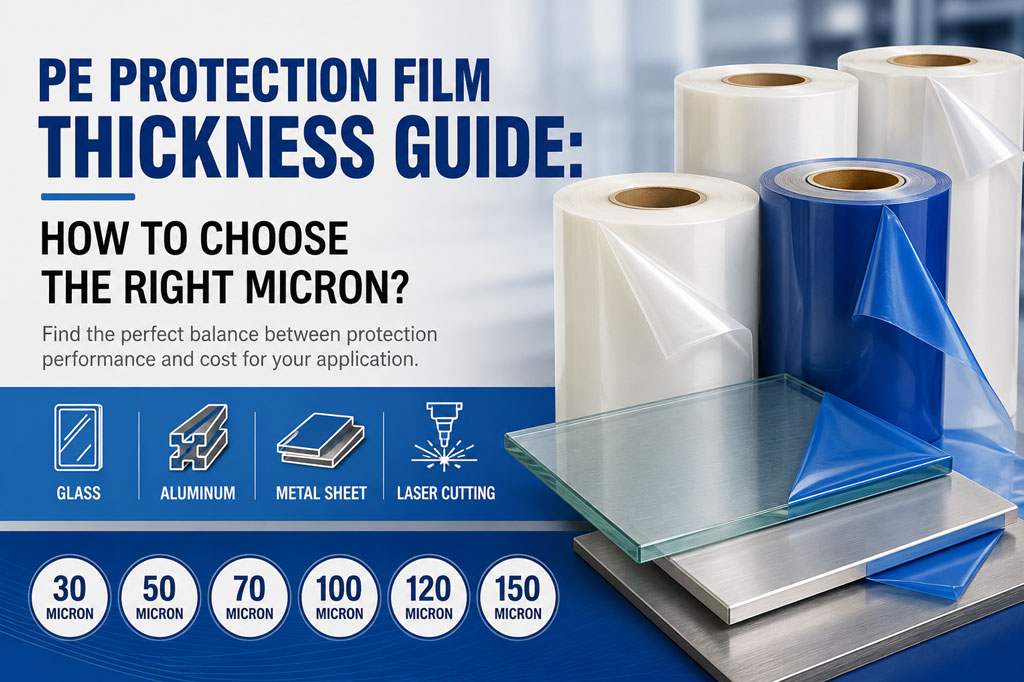
When selecting a PE protection film, thickness is one of the first specifications buyers notice—but thicker does not automatically mean better protection.
For industrial surface protection, PE film thickness commonly ranges from around 30 micron to 150 micron, depending on the surface, manufacturing process, expected mechanical stress, and required protection period.
This guide compares 30, 50, 70, 100, 120, and 150 micron PE protection films and explains how to select the right thickness for glass, aluminum, metal sheet, and laser cutting applications.
What Does “Micron” Mean in PE Protection Film?
A micron, or micrometer (μm), is one-thousandth of a millimeter.
For example:
| Film Thickness | Millimeters | General Positioning |
|---|---|---|
| 30 micron | 0.03 mm | Lightweight protection |
| 50 micron | 0.05 mm | General-purpose protection |
| 70 micron | 0.07 mm | Medium-duty protection |
| 100 micron | 0.10 mm | Heavy-duty protection |
| 120 micron | 0.12 mm | High-strength protection |
| 150 micron | 0.15 mm | Extra-heavy-duty protection |
Thickness affects several important properties of protective film, including:
- Puncture and tear resistance
- Impact and abrasion resistance
- Film stiffness
- Tensile strength
- Ease of manual handling
- Resistance to deformation during processing
- Material consumption and cost
However, thickness does not determine adhesion.
A 100-micron low-tack film can have significantly lower adhesion than a 50-micron high-tack film. Adhesion is primarily determined by the adhesive formulation and coating weight.
This distinction is important when specifying protective film.
30 Micron PE Protection Film
30 micron PE film is designed primarily for lightweight, short-term surface protection.
Because the film is thin and flexible, it conforms easily to smooth surfaces while using less polyethylene material.
Typical applications
30-micron film can be considered for:
- Smooth glass
- Mirrors
- High-gloss panels
- Smooth plastic sheets
- Indoor processing
- Short-distance transportation
- Low-risk assembly environments
For example, glass moving through cutting, inspection, assembly, and indoor storage may only require protection against fingerprints, dust, and light scratching.
In this situation, increasing thickness to 100 micron would add material cost without necessarily creating proportional value.
Limitations
30-micron films offer relatively limited resistance against:
- Sharp edges
- Heavy abrasion
- Punctures
- Aggressive metal fabrication
- Rough handling
Therefore, they are generally less suitable for demanding metal processing or laser cutting applications.
50 Micron PE Protection Film
50 micron is one of the most versatile thicknesses for general industrial surface protection.
It provides a practical balance between flexibility, mechanical strength, application performance, and cost.
Typical applications
50-micron PE protection film is widely suitable for:
- Glass
- Aluminum profiles
- Aluminum sheets
- Stainless steel
- Plastic panels
- Furniture panels
- Appliance surfaces
- Decorative sheets
For relatively smooth surfaces undergoing normal manufacturing, transportation, and installation, 50 micron is often a useful starting point for testing.
Why 50 micron is widely used
It provides enough mechanical strength for many handling operations without making the film unnecessarily heavy or rigid.
For manufacturers consuming large volumes of protective film, even a small reduction in film thickness can significantly affect annual polyethylene consumption.
Therefore, 50 micron can offer a good cost-performance balance when heavy mechanical protection is unnecessary.
70 Micron PE Protection Film
When processing conditions become more demanding, 70 micron provides an intermediate solution between standard and heavy-duty protective films.
It has greater body and mechanical durability than 30- or 50-micron films while remaining relatively flexible.
Typical applications
70-micron protective film is commonly considered for:
- Aluminum profiles
- Powder-coated aluminum
- Anodized aluminum
- Stainless steel sheets
- Pre-painted metal
- Decorative metal panels
- Construction materials
- Medium-duty fabrication
It is particularly useful where surfaces experience multiple production stages before the film is removed.
For example, an aluminum profile may go through fabrication, assembly, packing, transportation, storage, and installation. A slightly thicker film can better tolerate repeated handling throughout this process.
100 Micron PE Protection Film
At 100 micron, PE protection film enters the heavy-duty category.
The additional thickness provides greater resistance to tearing, puncturing, stretching, and mechanical damage.
Typical applications
100-micron PE film may be selected for:
- Stainless steel sheets
- Aluminum sheets
- Metal fabrication
- Construction panels
- Heavy aluminum profiles
- Laser cutting
- Long transportation cycles
- High-risk processing environments
This thickness becomes particularly useful when the protective film is not simply protecting a finished product in storage but must survive part of the manufacturing process itself.
That distinction is important.
A film covering stainless steel during warehouse storage faces completely different stresses from a film covering the same sheet during cutting, bending, punching, or fabrication.
120 Micron PE Protection Film
120 micron film provides additional mechanical stability for demanding industrial processing.
Compared with 100 micron, the extra thickness can improve resistance to tearing and deformation, especially when the film experiences high mechanical stress.
Typical applications
Potential applications include:
- Heavy-gauge metal sheets
- Stainless steel processing
- Aluminum sheet fabrication
- Laser cutting
- Construction materials
- Heavy-duty transportation
- Products with high damage costs
120 micron can also be useful when the protective film must remain intact through several fabrication processes.
However, increasing thickness should always be justified by actual production conditions. If a 70- or 100-micron film already survives the process reliably, moving to 120 micron may simply increase material cost.
150 Micron PE Protection Film
150 micron represents the extra-heavy-duty end of common PE surface protection film specifications.
It offers substantially more film body and mechanical durability than conventional lightweight films.
Typical applications
150-micron films can be considered for:
- Heavy metal fabrication
- Demanding laser cutting processes
- Thick metal plates
- High-value finished surfaces
- Rough transportation conditions
- Applications with high puncture risk
- Specialized industrial processing
However, 150 micron should not be treated as a universal “premium” specification.
For many applications, it would be excessive.
The objective of protective film engineering should be to find the minimum thickness that reliably survives the customer’s complete production and logistics cycle.
PE Protection Film Thickness by Application
Different surfaces and processes require very different protection strategies.
1. Glass Protection Film
For glass, the primary risks are often:
- Scratches
- Dust
- Paint contamination
- Fingerprints
- Construction debris
- Transportation damage
For smooth glass under controlled indoor conditions, 30–50 micron may provide sufficient protection.
For architectural glass or applications involving more transportation and installation handling, 50–70 micron may provide greater durability.
| Glass Application | Suggested Starting Range |
|---|---|
| Indoor processing | 30–50 μm |
| General glass protection | 50 μm |
| Transportation/installation | 50–70 μm |
| Higher mechanical risk | 70–100 μm |
The surface cleanliness and adhesive compatibility are often more important than simply increasing film thickness.
2. Aluminum Protection Film
Aluminum requires a more application-specific approach because the surface can vary significantly.
Common finishes include:
- Anodized aluminum
- Powder-coated aluminum
- Electrophoretic coating
- Polished aluminum
- Brushed aluminum
- Painted aluminum
- Wood-grain aluminum profiles
For relatively smooth aluminum surfaces, 50 micron is often a practical starting point.
For profiles that experience extensive fabrication, transportation, and installation, 70 micron can provide additional durability.
Heavy-duty applications may require 100 micron or above.
| Aluminum Application | Suggested Starting Range |
|---|---|
| Smooth aluminum sheet | 50 μm |
| Anodized aluminum | 50–70 μm |
| Powder-coated profiles | 50–70 μm |
| Fabrication and installation | 70–100 μm |
| Heavy-duty processing | 100–120 μm |
Importantly, rougher surfaces do not necessarily require thicker film alone. They may require higher or specially formulated adhesion to maintain consistent surface contact.
3. Metal Sheet Protection Film
Metal sheet processing generally places greater mechanical demands on protective film than simple glass protection.
Applications can include:
- Stainless steel
- Pre-painted steel
- Aluminum sheet
- Decorative metal
- Appliance panels
- Sandwich panel skins
- Metal fabrication components
A 50–70 micron film can be sufficient for normal handling and fabrication.
When the metal undergoes more demanding processing, 70–100 micron becomes more appropriate.
For particularly severe fabrication environments, 120 or 150 micron may be considered.
| Metal Sheet Application | Suggested Starting Range |
|---|---|
| Storage protection | 30–50 μm |
| General sheet handling | 50–70 μm |
| Fabrication | 70–100 μm |
| Heavy fabrication | 100–120 μm |
| Extreme mechanical protection | 120–150 μm |
4. Laser Cutting Protective Film
Laser cutting is one of the applications where protective film selection becomes considerably more technical.
The film needs to protect the metal surface while remaining stable during cutting.
Depending on the laser system, metal type, thickness, cutting parameters, adhesive formulation, and film structure, problems can include:
- Film lifting
- Edge shrinkage
- Burning
- Melting
- Adhesive residue
- Poor cut-edge quality
- Film tearing during subsequent processing
For this reason, laser cutting protective film should never be selected based on micron thickness alone.
Typical thickness range
For many metal laser cutting applications, manufacturers may evaluate:
70–150 micron PE protective films
with 100 micron being a useful heavy-duty specification to test for demanding fabrication.
| Laser Cutting Condition | Thickness to Evaluate |
|---|---|
| Relatively light processing | 70 μm |
| General laser-cut metal | 70–100 μm |
| Heavy-duty processing | 100–120 μm |
| Highly demanding applications | 120–150 μm |
These ranges should be treated as starting points for testing rather than universal specifications.
Laser type also matters. CO₂ and fiber laser systems interact differently with the material stack, and the film’s polymer formulation, adhesive system, and processing parameters all influence actual performance.
How to Choose the Right PE Protection Film Thickness
Instead of choosing micron thickness from a catalog, evaluate the complete application.
Consider these six questions:
1. What surface are you protecting?
Glass, aluminum, stainless steel, painted metal, and textured profiles have different requirements.
2. How rough is the surface?
Surface roughness primarily affects adhesive contact and adhesion requirements.
3. What manufacturing processes will occur after lamination?
Cutting, stamping, bending, drilling, laser cutting, and assembly can substantially increase mechanical stress.
4. How long will the film remain on the product?
A film used for several hours during manufacturing has different requirements from one remaining on a product for several months.
5. What happens during transportation and installation?
Construction products can experience significantly more abrasion and impact than products used in controlled factory environments.
6. What happens when the film is removed?
Successful protection does not end with surviving production.
The film must also peel cleanly without:
- Adhesive residue
- Surface contamination
- Difficult removal
- Ghosting
- Coating damage
Quick PE Protection Film Thickness Selection Chart
| Thickness | Protection Level | Typical Applications |
|---|---|---|
| 30 micron | Light | Glass, smooth panels, short-term indoor protection |
| 50 micron | General | Glass, aluminum, metal sheets, general manufacturing |
| 70 micron | Medium | Aluminum profiles, stainless steel, fabrication |
| 100 micron | Heavy | Metal fabrication, laser cutting, demanding handling |
| 120 micron | Heavy-duty | Heavy metal processing, laser cutting |
| 150 micron | Extra heavy-duty | Specialized fabrication and high mechanical stress |
These recommendations are starting points. Final specifications should be validated on the customer’s actual surface and production line.
Final Thoughts
Choosing the right PE protection film thickness requires balancing protection performance, processing conditions, adhesion, and cost.
As a general reference:
- 30 micron — lightweight protection
- 50 micron — general-purpose protection
- 70 micron — medium-duty industrial protection
- 100 micron — heavy-duty processing
- 120 micron — demanding fabrication
- 150 micron — extra-heavy-duty applications
But micron thickness should never be evaluated in isolation.
For industrial buyers, the most reliable selection method is to provide the protective film manufacturer with information about the substrate, surface finish, roughness, manufacturing process, protection period, transportation conditions, and removal requirements.
The manufacturer can then match the appropriate PE thickness, adhesive system, adhesion level, film strength, color, width, and other specifications, followed by sample testing under actual production conditions.
That approach avoids both under-specification, which can cause protection failures, and over-specification, which adds unnecessary material and cost.