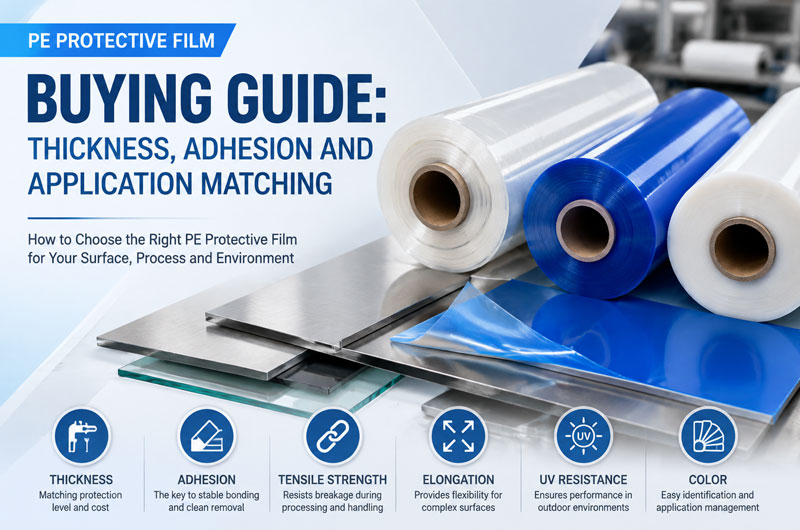
Many buyers focus only on film thickness and overlook other critical parameters such as adhesion level, tensile strength, elongation, UV resistance, and color identification.
A protective film that performs well on one material may fail completely on another. For example:
- A high-adhesion film that works for stainless steel may leave residue on painted surfaces.
- A thin film may be sufficient for indoor transportation but fail during outdoor storage.
- A low-tack film may peel off during laser cutting or bending processes.
Therefore, selecting PE protective film requires matching film properties with application conditions.
1. Thickness
Thickness is one of the most important selection factors for PE protective film.
Common thickness ranges:
| Thickness | Typical Application |
|---|---|
| 30–40 μm | Light protection, indoor transportation |
| 50–70 μm | General industrial protection |
| 80–100 μm | Heavy-duty processing protection |
| 120–150 μm+ | High-impact protection applications |
How Thickness Affects Performance
Thicker Film Advantages
A thicker PE film provides:
- Higher puncture resistance
- Better impact protection
- Improved protection during stamping, bending, and fabrication
- Reduced risk of surface damage
Applications:
- Aluminum profiles
- Stainless steel sheets
- Metal panels
- Construction materials
Thin Film Advantages
Thin films provide:
- Lower material cost
- Better conformability
- Easier application on curved surfaces
- Less waste during removal
Applications:
- Glass protection
- Plastic sheets
- Decorative panels
Thickness Selection Principle
Do not simply choose the thickest film.
The ideal thickness depends on:
Surface sensitivity + processing environment + transportation conditions
For example:
| Application | Recommended Thickness |
|---|---|
| Aluminum extrusion | 50–80 μm |
| Stainless steel coil | 60–100 μm |
| Glass panel | 40–60 μm |
| Laser cutting metal | 80–120 μm |
| Automotive interior parts | 40–70 μm |
2. Color
PE protective film colors are often selected based on production requirements rather than aesthetics.
Common colors include:
- Transparent
- Blue
- White
- Black/white
- Black
- Custom printed colors
Transparent Film
Advantages:
- Allows surface inspection
- Suitable for high-quality finished products
- Easy defect detection
Applications:
- Glass
- Acrylic sheets
- Display panels
Blue Protective Film
Blue film is one of the most recognizable industrial protection films.
Advantages:
- Easy visual identification
- Helps distinguish protected surfaces
- Reduces accidental removal during production
Applications:
- Aluminum profiles
- Stainless steel
- Appliances
Black and White Film
Commonly used for:
- Premium surfaces
- Decorative materials
- Automotive components
Benefits:
- Blocks UV exposure
- Provides better appearance management
- Protects sensitive surfaces
3. Adhesion
Adhesion determines how strongly the protective film bonds to the surface.
Too low adhesion:
- Film falls off during processing
- Dust enters underneath
- Poor protection performance
Too high adhesion:
- Difficult removal
- Adhesive residue
- Surface damage risk
The ideal adhesion is:
Strong enough to stay attached, but gentle enough for clean removal.
Typical Adhesion Levels
| Adhesion Level | Application |
|---|---|
| Low tack | Glass, polished surfaces |
| Medium tack | Aluminum, stainless steel |
| High tack | Rough metal surfaces, coated panels |
Adhesion Matching Examples
Stainless Steel
Challenges:
- Smooth surface
- Fingerprints
- Scratching risk
Recommended:
- Medium adhesion PE film
- High clarity
- Good residue resistance
Aluminum Profiles
Challenges:
- Powder coating
- Long transportation cycles
Recommended:
- Medium/high adhesion
- Good temperature resistance
Glass
Challenges:
- Low surface energy
- Clean appearance requirement
Recommended:
- Low adhesion
- Low residue adhesive system
4. Tensile Strength
Tensile strength refers to the maximum force a film can withstand before breaking.
Higher tensile strength means:
- Better handling performance
- Less tearing during application
- Better performance during fabrication
Important for:
- Cutting
- Bending
- Forming
- Transportation
Why Tensile Strength Matters
During manufacturing, protective film may experience:
- Mechanical pulling
- Machine tension
- Edge stress
- Impact force
If tensile strength is insufficient:
- Film tears during removal
- Fragments remain on the surface
- Production efficiency decreases
5. Elongation
Elongation measures how much the PE film can stretch before breaking.
High elongation provides:
- Better surface coverage
- Improved wrapping ability
- Reduced cracking during forming
Applications requiring high elongation:
- Curved aluminum profiles
- Automotive parts
- Plastic components
- Molded products
Tensile Strength vs Elongation
These two properties work together:
| Property | Main Function |
|---|---|
| Tensile Strength | Prevents breaking |
| Elongation | Provides flexibility |
A high-performance protective film requires a balanced combination.
A film that is very strong but lacks flexibility may crack.
A film that stretches easily but lacks strength may tear.
6. UV Resistance
For outdoor applications, UV resistance is a key consideration.
Without UV protection:
- PE film becomes brittle
- Adhesive performance changes
- Removal becomes difficult
- Residue risk increases
UV Resistant PE Protective Film Applications
Common industries:
- Aluminum windows and doors
- Building materials
- Solar-related components
- Outdoor metal panels
Typical UV resistance options:
| Storage Condition | Recommended UV Resistance |
|---|---|
| Indoor storage | Standard film |
| Short outdoor exposure | UV-resistant film |
| Long-term outdoor storage | High UV-resistant film |
7. Application Matching Guide
Different industries require different protective film specifications.
| Industry | Thickness | Adhesion | Key Requirements |
|---|---|---|---|
| Aluminum profiles | 50–80 μm | Medium | UV resistance, clean removal |
| Stainless steel | 60–100 μm | Medium | Scratch protection |
| Glass | 40–60 μm | Low | Transparency, residue-free |
| Laser cutting | 80–120 μm | Medium/high | Heat resistance, strength |
| PVC profiles | 50–80 μm | Medium | Weather resistance |
| Automotive parts | 40–70 μm | Low/medium | Flexibility |
Conclusion
Selecting PE protective film is not simply a price or thickness decision. The correct solution requires understanding the relationship between:
Film thickness → Protection level
Adhesion → Surface compatibility
Tensile strength → Processing durability
Elongation → Flexibility
UV resistance → Environmental reliability
For manufacturers, choosing the right PE protective film can reduce surface defects, improve production efficiency, and prevent costly rework.
As a reliable protective film supplier, Changsheng not only provides different film specifications but also helps customers match the right adhesive technology and film structure to their application.