When sourcing PET protective film, thickness is usually one of the first specifications buyers consider.
Should you choose 30 μm, 35 μm, 50 μm, or an even thicker PET film?
The intuitive answer might be: the thicker the film, the better the protection. In industrial applications, however, this is not always true.
PET film thickness affects not only mechanical protection, but also flexibility, conformability, handling, die-cutting performance, material consumption, and overall cost. More importantly, thickness must work together with adhesive strength and the condition of the protected surface.
This guide explains the common thicknesses of PET protective film and how to select the right micron range for your application.
What Does PET Protective Film Thickness Mean?
PET protective film thickness is normally expressed in microns (μm).
1 μm = 0.001 mm
For example:
| PET Film Thickness | Equivalent in mm |
|---|---|
| 25 μm | 0.025 mm |
| 30 μm | 0.030 mm |
| 35 μm | 0.035 mm |
| 50 μm | 0.050 mm |
| 75 μm | 0.075 mm |
| 100 μm | 0.100 mm |
Although the difference between a 30 μm and 50 μm film is only 0.02 mm, this difference can noticeably affect stiffness, puncture resistance, handling and material cost.
Compared with PE, PET inherently offers excellent tensile strength, low elongation and dimensional stability. Therefore, PET protective film can provide reliable protection even at relatively low thicknesses.
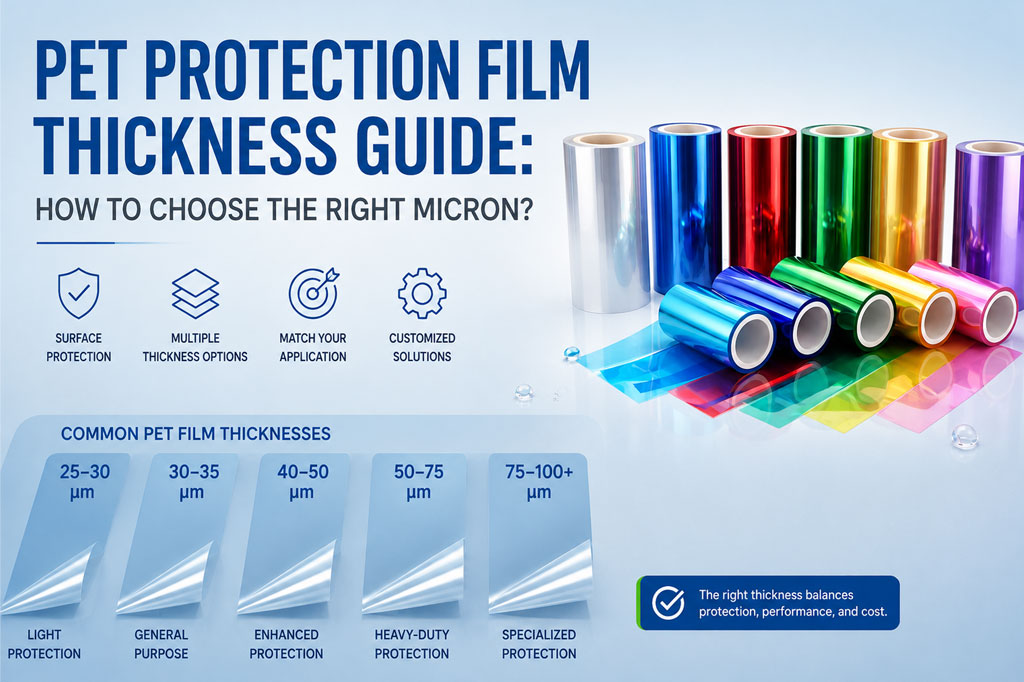
Common PET Protection Film Thicknesses
PET protective films can be manufactured in different thicknesses according to application requirements.
At Changsheng, our PET protective film solutions can be customized according to the protected surface, adhesion requirement, converting process and end-use environment.
The following ranges provide a practical way to understand common PET film thickness choices.
25–30 μm: Lightweight Protection
Thin PET protective films are designed for applications where the main requirement is preventing:
- Dust
- Fingerprints
- Minor scratches
- Light abrasion
- Contamination during assembly
Because less material is used, thinner PET films can also be an economical solution for large-volume production.
Typical applications include:
- Smooth plastic sheets
- Electronic components
- Display surfaces
- Glossy panels
- Light-duty industrial protection
- Short-term processing protection
However, very thin film provides less cushioning against stronger mechanical impacts.
For surfaces that experience frequent handling, cutting, transportation or stacking, moving to a thicker PET substrate may provide a better safety margin.
30–35 μm: A Practical General-Purpose Range
For many PET surface protection applications, 30–35 μm provides a useful balance between protection, handling and cost.
This thickness range is particularly suitable when the substrate itself is relatively smooth and the main purpose of the film is to prevent scratches and contamination rather than absorb heavy impacts.
Changsheng’s featured PET protective film products, for example, include 30 μm and 35 μm options, with different adhesive strengths available for smooth, flat, slightly textured and rough surfaces.
Typical applications can include:
- Stainless steel
- Aluminum sheets
- Decorative metal
- Acrylic sheets
- PC sheets
- PVC panels
- Displays
- Electronic housings
An important point here is that the same 30 or 35 μm PET carrier can be combined with different adhesion levels.
Therefore, film thickness does not determine which surface the film can protect by itself.
40–50 μm: Enhanced Mechanical Protection
When products experience more intensive processing, handling or transportation, buyers may consider PET protective film around 40–50 μm.
Compared with thinner films, this range generally provides:
- Greater stiffness
- Better puncture resistance
- Improved resistance to handling damage
- More robust protection during fabrication
- Easier handling in some automated processes
Typical applications may include:
- Metal fabrication
- Decorative metal sheets
- Appliance panels
- High-value plastic sheets
- Industrial components
- Products undergoing multiple processing steps
For example, if a decorative metal panel passes through cutting, forming, assembly, storage and transportation before reaching the customer, a very thin protective film may be more vulnerable to damage during the process.
A thicker PET film provides additional physical protection.
But that does not automatically mean that 50 μm should replace 30–35 μm in every application. If the process is relatively gentle, the additional material may simply increase cost without creating meaningful protection benefits.
50–75 μm: Heavy-Duty Protection
PET film in the 50–75 μm range can be considered when the protected component faces higher mechanical stress.
Typical situations include:
- Repeated handling
- Long manufacturing processes
- Stacking of finished components
- More demanding transportation conditions
- Higher-value finished surfaces
- Applications requiring increased film rigidity
This range can also be useful for some converting and die-cutting applications where dimensional stability is particularly important.
The key question is not:
“Is 75 μm stronger than 35 μm?”
It obviously is.
The better question is:
“Does my application actually require the additional mechanical strength?”
That distinction can significantly affect purchasing cost when millions of square meters of protective film are consumed annually.
75–100+ μm: Specialized Protection
Thicker PET protective films are generally used for more specialized requirements rather than ordinary temporary surface protection.
Possible applications include:
- Heavy-duty industrial protection
- High-value precision components
- Special die-cut protection
- Functional PET film structures
- Applications requiring high stiffness
- Customized multi-layer protection solutions
At these thicknesses, buyers should carefully evaluate whether PET protective film is being used simply as temporary surface protection or as part of a more specialized functional structure.
For standard scratch and contamination protection, unnecessarily increasing film thickness may offer diminishing returns.
PET Protective Film Thickness Comparison
| Thickness | Protection Level | Flexibility | Typical Applications |
|---|---|---|---|
| 25–30 μm | Light | High | Displays, plastics, smooth surfaces |
| 30–35 μm | Light–Medium | High | Metal, plastic sheets, electronics, general protection |
| 40–50 μm | Medium | Medium | Fabricated metal, appliances, decorative panels |
| 50–75 μm | Medium–Heavy | Medium–Low | Industrial processing, transportation, high-value surfaces |
| 75–100+ μm | Heavy/Specialized | Lower | Specialized industrial and functional applications |
These ranges should be treated as selection guidelines rather than universal specifications. The correct film depends on the entire application.
Conclusion
Choosing PET protective film thickness should not be reduced to the idea that “thicker is better.”
For light-duty surface protection, 25–35 μm may already provide sufficient performance. For more demanding manufacturing and transportation environments, 40–75 μm can provide additional mechanical protection, while thicker films are generally reserved for specialized applications.
More importantly, thickness should always be evaluated together with surface roughness, adhesion, processing conditions, application equipment and protection duration.