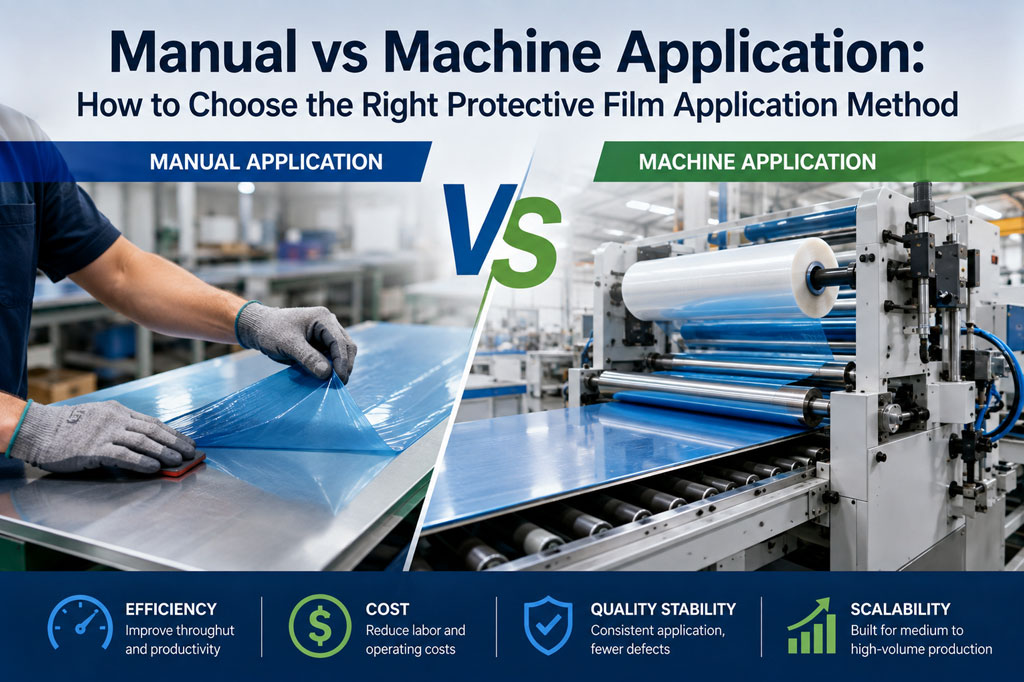
Protective film is generally applied in one of two ways:
- Manual application
- Machine or automated application
Manual application offers flexibility and requires relatively little investment, while machine application provides higher throughput and greater process consistency. Neither method is universally better. The right choice depends on production volume, product geometry, line speed, quality requirements, labor costs, and the characteristics of the protective film.
This article compares manual and machine protective film application from four important perspectives: efficiency, cost, quality consistency, and suitable production scale.
1. What Is Manual Protective Film Application?
Manual application means an operator positions the protective film and applies it to the surface by hand, sometimes using simple tools such as rubber rollers, squeegees, cutting knives, or hand-operated dispensers.
A typical process may involve:
- Cleaning the product surface.
- Positioning the protective film roll or pre-cut sheet.
- Aligning the film with the product edge.
- Gradually applying the film while controlling tension.
- Pressing the film with a roller or squeegee.
- Cutting excess film and inspecting the finished surface.
Manual application is particularly common in small factories, workshops, project-based production, prototyping, and applications involving irregularly shaped products.
Its biggest advantage is flexibility.
Operators can quickly switch between different dimensions, shapes, film types, and products without changing machine settings or production-line tooling.
However, this flexibility comes with a trade-off: the application result depends heavily on operator experience.
2. What Is Machine Protective Film Application?
Machine application uses dedicated laminating equipment or an integrated production-line system to continuously apply protective film.
A typical system may include:
Film unwinding → tension control → product feeding → film alignment → laminating rollers → cutting → inspection
Instead of an operator manually controlling the film, the machine maintains relatively consistent pressure, speed, alignment, and tension.
This approach is widely used for continuous or standardized products such as:
- Aluminum profiles
- Stainless steel sheets and coils
- Glass panels
- Plastic sheets
- Decorative panels
- Metal panels
- Appliance components
- Extruded profiles
Machine application can range from a relatively simple semi-automatic laminator to a fully automated system integrated directly into an extrusion, coating, cutting, or panel production line.
The key advantage is not simply speed. It is repeatability at scale.
3. Efficiency
For very small batches, manual application can actually be more efficient.
Imagine a manufacturer needs protective film on only 20 customized panels. Setting up a laminating machine, adjusting roller pressure, loading film, testing alignment, and calibrating parameters may take longer than simply applying the film manually.
The situation changes dramatically when production reaches hundreds or thousands of identical parts.
Manual application capacity is directly linked to operator speed. As production volume increases, manufacturers generally need more operators.
Machine application works differently.
Once operating parameters are established, film can be applied continuously as products move through the production line.
| Factor | Manual Application | Machine Application |
|---|---|---|
| Initial setup | Fast | Requires setup |
| Small-batch efficiency | High | Moderate |
| Large-volume efficiency | Low | High |
| Application speed | Operator-dependent | Consistent |
| Continuous production | Difficult | Well suited |
| Production scalability | Labor-dependent | Equipment-dependent |
This leads to an important purchasing principle:
The higher and more repetitive the production volume, the stronger the economic case for automated application.
4. Cost
Manual application initially appears much cheaper.
A factory may need only operators, rollers, cutters, and simple worktables. An automated laminating system, by comparison, requires capital investment.
But initial investment does not represent the true cost of protective film application.
Manufacturers should consider the cost per successfully protected product, including:
- Labor
- Equipment depreciation
- Protective film waste
- Rework
- Damaged products
- Production downtime
- Inspection
- Training
- Application defects
Suppose manual application costs very little to establish but requires several workers on every shift. As production increases, labor costs rise almost proportionally.
An automated system has the opposite cost structure: high initial investment but potentially much lower incremental application cost.
Therefore:
Low-volume production usually favors manual application, while high-volume repetitive manufacturing increasingly favors automation.
The break-even point will differ significantly between factories because labor costs, product value, line speed, equipment cost, and defect rates vary.
5. Quality Consistency
One of the biggest differences between manual and machine application is often overlooked: process consistency.
When workers manually apply protective film, several parameters can change from one product to another:
- Film tension
- Application angle
- Roller pressure
- Application speed
- Edge alignment
- Contact sequence
An experienced operator may achieve excellent results. However, reproducing exactly the same conditions across thousands of products and multiple shifts is difficult.
This can result in defects such as:
- Wrinkles: Uneven film feeding or tension can cause folding.
- Air bubbles: Incorrect application angle or insufficient pressure can trap air.
- Misalignment: Film may shift away from the required coverage area.
- Stretching: Excessive pulling can deform thin PE protective films.
Poor edge adhesion: Insufficient pressure can prevent complete adhesive-to-surface contact.
Automated equipment reduces these variables by controlling pressure, tension, feeding direction, and application speed.
For high-volume manufacturing, this consistency can be more valuable than the increase in production speed itself.
6. Protective Film Selection Becomes More Important with Automation
A common mistake is assuming that any protective film that works manually will automatically work well on a laminating machine.
This is not necessarily true.
Automated application introduces additional requirements related to film processing behavior.
Film Unwinding
The film should unwind smoothly and consistently. Excessive or unstable unwind force can interfere with tension control.
Film Flatness
Poor roll quality, telescoping, wrinkles, or uneven winding can create problems at higher application speeds.
Tensile and Elongation Behavior
The film needs sufficient mechanical stability to withstand machine tension without excessive stretching.
PE films, for example, can elongate under tension. If the machine pulls too aggressively, the film may stretch during application and subsequently attempt to recover.
Adhesive Performance
Machine lamination pressure can produce more uniform adhesive contact than hand application. Adhesion therefore needs to be evaluated under the customer’s actual processing conditions rather than only through laboratory peel-strength numbers.
Roll Dimensions
Roll width, roll length, core diameter, and winding direction should match the laminating equipment.
This is why manufacturers using automated production lines should treat protective film as a production-line material, not simply as packaging material.
7. Product Geometry Can Determine the Application Method
Production volume alone should not determine whether automation is appropriate.
Product geometry is equally important.
Large, flat, standardized surfaces are ideal candidates for machine application because the film can travel along a predictable path.
Examples include:
- Sheet metal
- Flat glass
- Stainless steel panels
- Acrylic sheets
- Decorative panels
Continuous profiles can also be highly suitable for automated application when equipment is specifically designed around the profile geometry.
However, complex three-dimensional parts, deeply curved surfaces, assemblies, or products requiring protection only in specific areas may still benefit from manual application.
This creates an important distinction:
Automation works best when the surface and application path are predictable. Manual application performs better when frequent human adjustment is required.
8. Which Production Scale Should Use Which Method?
There is no universal production-volume threshold because products vary enormously in size and complexity. However, manufacturers can use the following framework.
Low-Volume or Prototype Production — Manual Application
Manual application is usually suitable when:
- Production quantities are small.
- Product dimensions change frequently.
- Many different protective films are used.
- Products have irregular geometries.
- Capital investment needs to remain low.
- Production is project-based rather than continuous.
Flexibility is more valuable than maximum throughput in these environments.
Medium-Volume Production — Semi-Automatic Application
Semi-automatic equipment can provide an effective middle ground.
The operator may position or feed the product while the machine controls film unwinding and roller pressure.
This approach reduces repetitive labor while avoiding the investment and complexity of a fully automated line.
It is especially useful when production volumes are increasing but product variety remains relatively high.
High-Volume Continuous Production — Automated Application
Full machine application becomes increasingly attractive when:
- Production runs continuously.
- Products are standardized.
- Surface dimensions are consistent.
- Line speed is important.
- Labor reduction is a priority.
- Quality consistency is critical.
- Protective film is applied to almost every finished product.
In this environment, protective film application effectively becomes another controlled manufacturing process.
9. Quick Comparison Between Manual and Machine Application
| Consideration | Manual Application | Machine Application |
|---|---|---|
| Initial investment | Low | Medium to high |
| Labor requirement | High | Low to moderate |
| Application speed | Low to moderate | High |
| Quality consistency | Operator-dependent | High |
| Flexibility | Very high | Moderate |
| Changeover | Easy | Requires adjustment |
| Complex shapes | Suitable | More difficult |
| Flat standardized surfaces | Suitable | Excellent |
| Large production volumes | Less suitable | Excellent |
| Small batches | Excellent | Often unnecessary |
| Process repeatability | Moderate | High |
| Integration with production line | Limited | Excellent |
10. A Better Decision Framework
A useful way to choose between manual and machine application is to evaluate two variables simultaneously:
production volume × product variety
- High variety + low volume → Manual application
- High variety + medium volume → Manual or semi-automatic application
- Low variety + medium volume → Semi-automatic application
- Low variety + high volume → Automated application
This framework explains why two manufacturers producing similar products may choose completely different application methods.
For example, a custom architectural metal fabricator may manufacture many panel dimensions in relatively small quantities. Manual or semi-automatic application provides valuable flexibility.
A stainless steel sheet manufacturer producing thousands of standardized sheets every day has very different requirements. Continuous automated lamination is much more logical.
The question, therefore, should not simply be:
“Is machine application better than manual application?”
A better question is:
“At what point does our production become repetitive enough that automation creates more value than flexibility?”