When buyers specify a temporary surface protective film, they usually focus first on adhesion, thickness, film material, and dimensions. Color is often treated as a secondary decision—something chosen mainly for appearance.
In practice, temporary protective film color can be a functional specification.
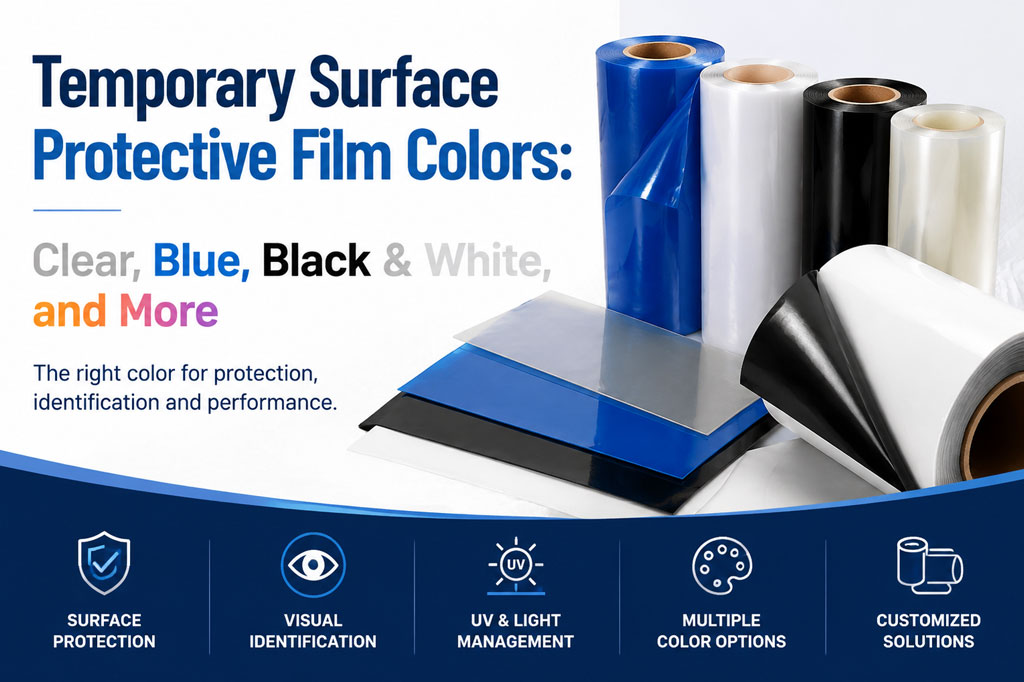
Clear, blue, black and white, black-and-white, and other customized colors can affect surface visibility, light transmission, product identification, production management, outdoor exposure, and even whether workers notice and remove the film at the correct stage.
So, choosing the right temporary protective film color should therefore be part of the overall protection strategy.
Why Does Protective Film Color Matter?
The primary function of temporary protective film is always the same: protecting a finished surface against scratches, dust, contamination, fingerprints, and processing or installation damage.
However, the color of the film can add a second layer of functionality.
For example, a transparent film allows operators to inspect the surface without peeling it back. A blue film makes it easier to distinguish a protected component from an unprotected one. An opaque black-and-white film can help reduce light exposure while creating a highly visible protective layer.
This means color selection should be based on more than aesthetics.
A useful way to think about it is:
Adhesive determines how the film interacts with the surface; color determines how the film interacts with the production environment.
That distinction is particularly important in large-scale manufacturing.
1. Clear Protective Film: When Surface Visibility Matters
Clear or transparent protective film is widely used for glass, stainless steel, aluminum, plastic sheets, decorative panels, and other finished surfaces.
Its biggest advantage is obvious: the protected surface remains visible.
This can be valuable when manufacturers need to perform visual inspections during production.
Workers can check:
- Surface color
- Scratches or defects
- Coating consistency
- Product markings
- Assembly position
- General appearance
without removing the protective layer.
Where Clear Film Works Well
Clear protective film is particularly suitable for products where visual appearance must remain visible throughout fabrication, assembly, transportation, or installation.
Typical applications include:
- Stainless steel sheets
- Aluminum profiles
- Glass
- Acrylic and plastic sheets
- Painted metal
- Furniture panels
- Appliance surfaces
- Decorative materials
However, transparency also has a disadvantage: operators may sometimes overlook the film because it visually blends into the substrate.
For applications where workers must quickly identify whether a surface has been protected, a colored film may provide better process control.
2. Blue Protective Film: More Than an Industry Tradition
Blue is one of the most recognizable colors in the temporary protective film industry.
It is frequently seen on aluminum profiles, stainless steel, metal panels, glass, plastic sheets, and appliance components.
But why blue?
One practical reason is visibility without excessive visual obstruction.
A translucent blue film can clearly indicate that a surface is protected while still allowing some visibility of the material underneath. This creates a useful compromise between transparent and fully opaque films.
Blue also stands out against many common industrial surfaces, including silver aluminum, stainless steel, white panels, and transparent glass.
Blue Film as a Production Indicator
Consider a factory processing thousands of aluminum profiles every day.
Workers need to quickly distinguish between:
- Protected profiles
- Unprotected profiles
- Processed components
- Components awaiting further operations
A visible blue protective layer makes this distinction easier from a distance.
In this situation, color becomes part of the factory’s visual management system, not simply part of the packaging.
This is one reason blue protective film has become so common across metal fabrication and profile manufacturing.
3. Black and White Protective Film: Light Management and High Visibility
Black-and-white protective film is commonly used when greater opacity or light shielding is required.
A typical design combines a white outer surface with a black inner layer, although constructions can vary according to application requirements.
The white exterior helps reflect part of the incoming light and heat, while the darker layer increases opacity.
This type of construction can be useful for products that are sensitive to prolonged light exposure or where the customer simply wants the protected surface to remain concealed during transportation, storage, or installation.
Applications may include:
- Metal sheets
- Aluminum composite panels
- Decorative sheets
- Plastic panels
- Building materials
- Outdoor construction components
Another advantage is visibility. A black-and-white film is difficult to overlook, which can help ensure that installers recognize the temporary layer before final handover.
It is important, however, not to assume that color alone provides sufficient outdoor protection. Outdoor protective film performance depends heavily on the complete film system—including UV stabilization, adhesive formulation, exposure time, temperature, substrate, and environmental conditions.
A black-and-white film is therefore not automatically a “UV-resistant film.”
4. White Protective Film: Clean Appearance and Strong Contrast
White protective film can be useful where a clean, uniform appearance is preferred during manufacturing or installation.
It is frequently considered for:
- Building panels
- Decorative boards
- Metal surfaces
- Appliance components
- Doors
- Furniture materials
White film can also provide strong visual contrast against darker substrates.
For example, on black painted metal or dark decorative panels, clear film may be difficult to identify. White film immediately shows which areas remain protected.
This seemingly small difference can reduce mistakes during handling and assembly.
5. Black Protective Film: Maximum Visual Blocking
Black protective film provides much stronger visual blocking than transparent or lightly colored films.
It can be useful where manufacturers want to conceal the substrate or reduce light transmission through the protective layer.
However, black film requires careful application analysis, particularly in environments exposed to strong sunlight.
Dark surfaces generally absorb more solar energy than light-colored surfaces. Depending on the substrate, adhesive, climate, and exposure conditions, this can contribute to higher surface temperatures.
Therefore, when a protective film will be used outdoors, color should be evaluated together with:
- UV resistance
- Temperature resistance
- Adhesive stability
- Outdoor exposure period
- Substrate sensitivity
This is a good example of why choosing protective film purely by color can be misleading.
6. Other Colors: Red, Green, Yellow and Custom Protective Films
Protective films do not have to be limited to clear, blue, white, or black.
Protective film can also be produced in colors such as:
- Red
- Green
- Yellow
- Gray
- Milky white
- Customized brand colors
For many industrial customers, these colors are less about appearance and more about classification.
Imagine a manufacturer operating several production lines.
Blue film could identify standard products, red could indicate products requiring additional inspection, and green could identify components approved for the next production stage.
Similarly, different colors could distinguish product grades, factories, customers, surface treatments, or manufacturing batches.
In this context, protective film effectively becomes a low-cost visual identification layer.
Protective Film Color Comparison
| Film Color | Surface Visibility | Visual Identification | Light Blocking | Typical Applications |
|---|---|---|---|---|
| Clear | Excellent | Low | Low | Glass, stainless steel, decorative surfaces |
| Blue | Good to moderate | Excellent | Moderate | Aluminum profiles, metal, glass, plastic |
| White | Low | Excellent | Higher than clear film | Panels, appliances, building materials |
| Black | Very low | Excellent | High | Light-sensitive or concealed surfaces |
| Black & White | Very low | Excellent | High | Panels, metal sheets, outdoor applications* |
| Custom Colors | Depends on color | Excellent | Depends on color | Production identification, branding |
Outdoor suitability must be verified according to UV resistance, adhesive formulation, substrate, climate, and required exposure period.
How to Choose the Right Protective Film Color
Instead of asking only, “What color do we want?”, buyers should ask what the color needs to accomplish.
If continuous surface inspection is important, clear film is usually the logical starting point.
If workers need to immediately recognize protected products, blue or another visible color may be more appropriate.
If opacity and light blocking are priorities, black, white, or black-and-white constructions deserve consideration.
If multiple product grades or production processes need to be distinguished, customized colors can become part of the factory’s visual management system.
And if brand exposure is important, customized color combined with printed logos and instructions can turn temporary protection into a branding opportunity.