Behind Low-E (Low Emissivity) glass’s excellent thermal performance lies a critical vulnerability that is often overlooked:
the exposed edge of the insulating glass unit (IGU)
The excellent thermal performance of Low-E glass depends heavily on the silver-based coating layer. While this coating provides outstanding infrared reflection and heat insulation, it is also highly sensitive to environmental exposure.
Once oxygen and moisture enter through the unprotected edge, the silver coating may gradually oxidize, causing:
- Reduced thermal insulation performance
- Visible discoloration or edge corrosion
- Shortened service life of insulating glass units
- Potential failure of the entire glazing system
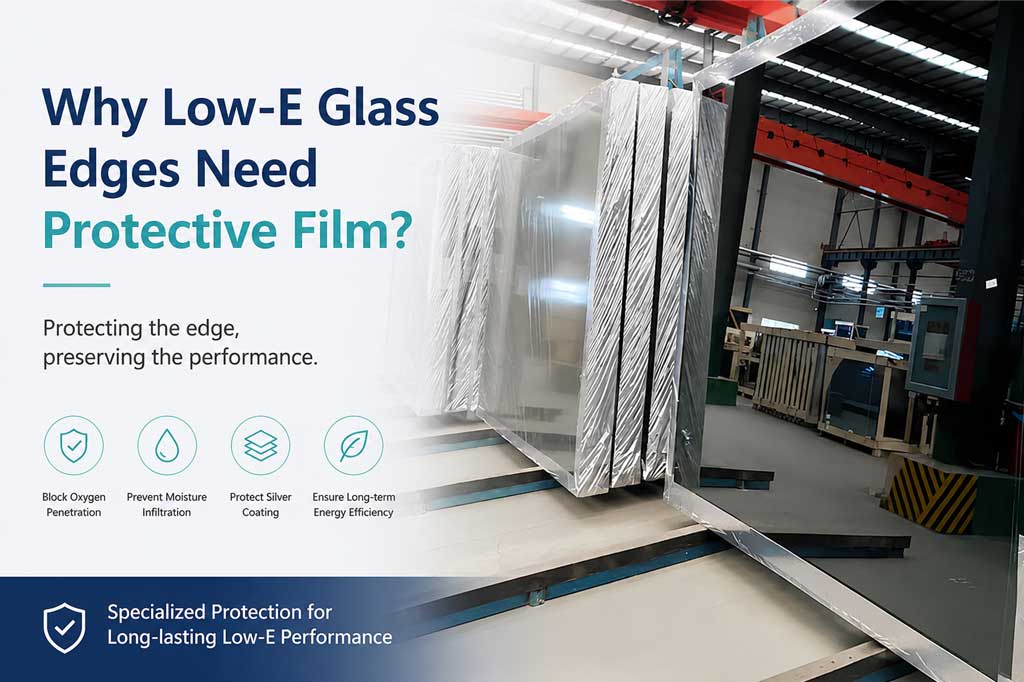
This is why Low-E glass edge protection film plays a critical role in preserving long-term performance.
1. Why Is the Silver Coating in Low-E Glass So Important?
Unlike traditional clear glass, Low-E glass contains a microscopically thin functional coating system, typically including one or multiple layers of silver (Ag).
The silver layer works as a highly efficient infrared reflector.
When sunlight reaches the glass:
- Visible light passes through
- Infrared radiation is reflected
- Heat transfer between indoor and outdoor environments is reduced
This unique property allows Low-E glass to achieve:
- Lower U-value
- Better thermal insulation
- Reduced energy consumption
- Improved indoor temperature stability
However, the same silver layer that delivers energy-saving performance also creates a material challenge:
Silver is chemically active and vulnerable to oxidation.
2. The Hidden Threat: Oxygen Penetration Through Low-E Glass Edges
Many people assume that once Low-E glass is sealed into an insulating glass unit, the coating is completely protected.
In reality, the edge area remains the most vulnerable part of the structure.
An insulating glass unit typically consists of:
- Two or more glass panes
- Spacer frame
- Sealant system
- Gas-filled cavity (such as argon)
The Low-E coating is usually positioned inside the cavity to protect it from direct contact with the external environment.
However, the glass edge is different.
During processing, transportation, installation, or long-term operation:
- The glass edge may be exposed
- The coating layer may come close to the edge surface
- Oxygen molecules can slowly migrate through microscopic gaps
Over time, oxygen and moisture can reach the silver layer.
This triggers oxidation reactions:
Silver coating + oxygen/moisture → silver oxide corrosion → performance degradation
Although this process may happen slowly, the impact becomes significant over years of building operation.
3. Why Edge Protection Is More Important Than Surface Protection
Most glass protection solutions focus on preventing:
- Scratches
- Dust contamination
- Handling damage
However, Low-E glass requires a different protection strategy.
The biggest risk is not mechanical damage on the glass surface.
The real challenge is:
Preventing chemical degradation of the functional coating layer.
A traditional protective film placed on the glass surface cannot solve this problem because oxidation starts from the edge.
The protection must be designed specifically for:
- Glass edge sealing
- Oxygen blocking
- Moisture resistance
- Long-term adhesion stability
This is where specialized Low-E glass edge protective film becomes essential.
4. How Low-E Glass Protective Film Prevents Oxidation
Changsheng’s Low-E glass protective film is specifically developed for edge protection applications.
Unlike conventional surface protection films, this solution focuses on creating an additional barrier layer at the exposed edge.
Its working principle includes:
Blocking Oxygen Transmission
The film forms a continuous protective barrier that reduces oxygen migration from the external environment into the glass cavity.
By limiting oxygen exposure, the silver coating remains stable for a longer period.
Preventing Moisture Infiltration
Humidity is another major factor accelerating silver oxidation.
The protective film helps reduce moisture penetration pathways, improving the durability of the Low-E coating system.
Maintaining Long-Term Edge Protection
Low-E glass is expected to serve for decades in modern buildings.
Therefore, edge protection materials must maintain:
- Stable adhesion
- Environmental resistance
- Aging resistance
- Compatibility with glass processing conditions
A specialized Low-E protective film is engineered around these requirements.
5. Why Ordinary Protective Films Cannot Replace Low-E Edge Protection Film?
A common misunderstanding is:
“Can normal PE or PET protective film protect Low-E glass?”
The answer is usually no.
Traditional protective films are mainly designed for:
| Function | Traditional Surface Protection Film | Low-E Edge Protective Film |
|---|---|---|
| Scratch protection | ✓ | ✓ |
| Dust protection | ✓ | ✓ |
| Edge sealing | Limited | ✓ |
| Oxygen barrier | Limited | ✓ |
| Moisture resistance | Limited | ✓ |
| Silver coating protection | No | ✓ |
The difference is not simply the film material.
The key difference is:
Low-E edge protection film is designed around the chemical protection requirements of silver coating systems.
6. Changsheng Specialized Solution for Edge Protection
As a professional protective film manufacturer, Changsheng developed a dedicated Low-E glass protective film solution based on the unique challenges of silver coating protection.
Compared with conventional protective films, our solution provides:
Exclusive patented technology
The film is specially designed for Low-E glass edge applications, creating a reliable protective barrier against environmental exposure.
Excellent sealing performance
The film helps reduce oxygen and moisture penetration, protecting the silver-based coating from oxidation.
Customized manufacturing capability
Different Low-E glass manufacturers and processing conditions may require different:
- Film thickness
- Adhesive strength
- Barrier performance
- Application methods
Changsheng provides customized solutions based on customer requirements.