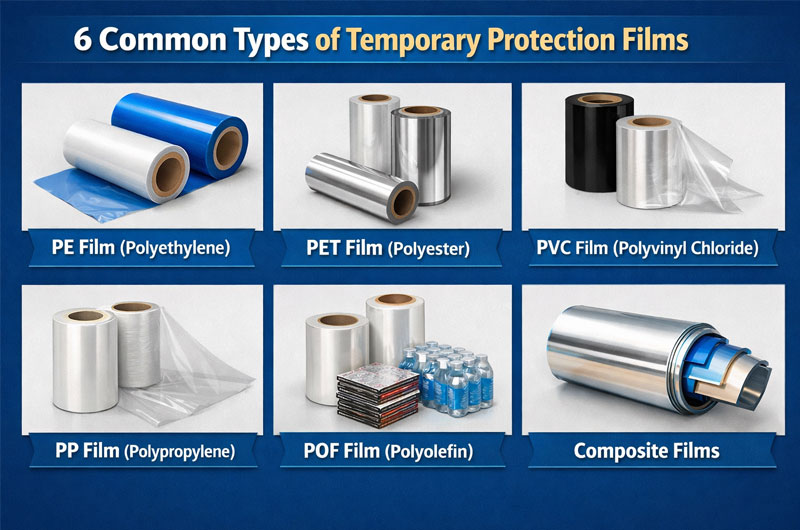
Temporary protective films are widely used across industries to shield surfaces during manufacturing, transport, storage, and installation. They help prevent scratches, contamination, and damage while allowing clean, residue-free removal.
One of the most important ways to classify temporary protection films is by material type, as the material determines performance, cost, application suitability, and environmental impact.
This article provides a comprehensive overview of the main types of temporary protection films by material, including their properties, advantages, disadvantages, and typical applications.
1. Polyethylene (PE) Protective Film
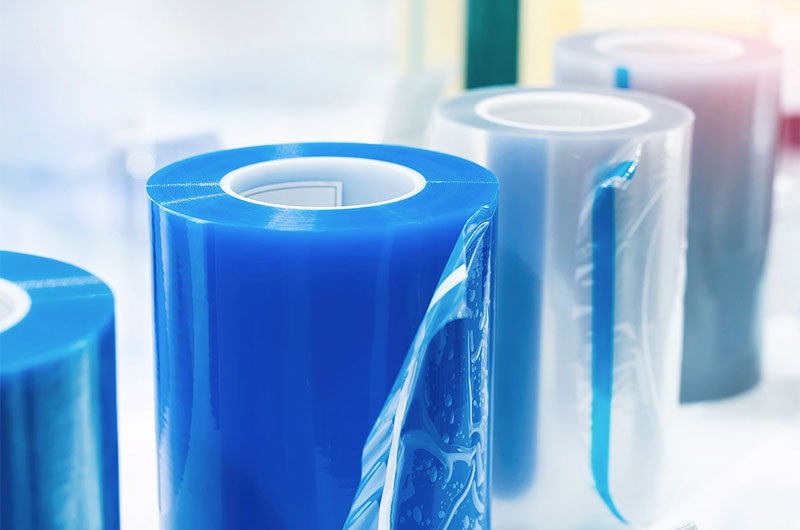
Polyethylene (PE) is the most widely used material for temporary protection films due to its flexibility, affordability, and versatility.
Key Characteristics
- Soft, flexible, and stretchable
- Low cost and easy to process
- Good environmental performance (especially water-based adhesive systems)
- Commonly applied in low to moderate temperature conditions
Advantages
- Excellent conformability for flat and slightly curved surfaces
- Easy application and clean removal without residue
- Wide range of adhesion levels (low to ultra-high tack)
- Cost-effective for large-scale industrial use
Disadvantages
- Limited heat resistance
- Not ideal for long-term outdoor exposure
Typical Applications
- Aluminum profiles
- Stainless steel sheets
- Glass panels
- Plastic sheets
- Floor protection
PE protective film is ideal for general-purpose, short-term protection, especially in construction, metal processing, and home appliance industries.
2. Polyethylene Terephthalate (PET) Protective Film
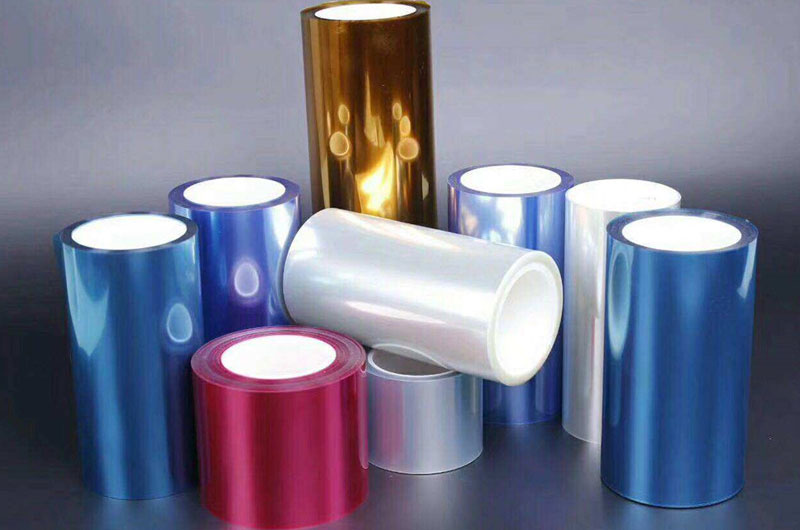
PET (polyester) film offers excellent strength, high clarity, and strong thermal stability, making it ideal for more demanding applications.
Key Characteristics
- High tensile strength and rigidity
- Excellent heat resistance
- Superior transparency and smooth surface
- Good chemical and moisture resistance
Advantages
- Excellent scratch and abrasion resistance
- Maintains dimensional stability (no stretching or deformation)
- Ideal for high-precision surfaces
- Suitable for optical-grade applications
Disadvantages
- Higher cost compared to PE
- Lower flexibility, not suitable for complex or curved surfaces
Typical Applications
- Electronic screens and displays
- Optical components
- High-end aluminum panels
- Automotive interior and exterior parts
PET protective film is best suited for high-performance, high-precision applications where clarity, durability, and heat resistance are critical.
3. Polyvinyl Chloride (PVC) Protective Film
PVC (polyvinyl chloride) is a cost-effective and versatile material valued for its flexibility and adaptability.
Key Characteristics
- Flexible and adaptable to various surface shapes
- Available in rigid and soft forms
- Moderate heat and chemical resistance
- Good weather resistance
Advantages
- Strong protection against scratches and minor impacts
- Suitable for both indoor and certain outdoor applications
- Easy to process and apply
- Cost-effective for short-term use
Disadvantages
- Less environmentally friendly compared to PE and PET
- May degrade under prolonged UV exposure
- Lower dimensional stability compared to PET
Typical Applications
- Plastic panels and sheets
- Furniture surfaces
- Decorative laminates
- Automotive interior components
PVC protective film is commonly used for flexible and short-term protection applications, especially where cost control is important.
4. Polypropylene (PP) Protective Film
Polypropylene (PP) films offer a balance between the flexibility of PE and the strength of PET.
Key Characteristics
- Lightweight and moderately flexible
- Better heat resistance than PE
- Good chemical resistance
- Environmentally friendly option
Advantages
- Balanced performance between flexibility and durability
- Suitable for electronic and display applications
- Improved thermal stability compared to PE
Disadvantages
- Less durable than PET
- Less flexible than PE
Typical Applications
- LCD and electronic display protection
- Plastic components
- Industrial packaging
PP protective film is often selected for mid-range performance applications, especially in electronics and precision industries.
5. Polyolefin (POF) Protective Film
Polyolefin (POF) films are commonly used in shrink and packaging applications, offering excellent clarity and strength.
Key Characteristics
- High durability and puncture resistance
- Excellent transparency and gloss
- Strong sealing and shrink capabilities
Advantages
- Suitable for irregular shapes and bundled products
- Recyclable and suitable for food-related applications in some cases
- Strong and versatile material
Disadvantages
- Higher cost than PE
- Primarily used for packaging rather than surface protection
Typical Applications
- Industrial product packaging
- Shrink wrapping
- Bundling and transport protection
POF films are ideal for high-end packaging protection, particularly where visual presentation and strength are important.
6. Composite & Metallized Films
Specialty films include multilayer, coated, or metallized structures designed for advanced applications.
Key Characteristics
- Multi-layer construction (e.g., PET + adhesive + functional coatings)
- Enhanced barrier properties (moisture, oxygen, UV)
- Customizable performance characteristics
Advantages
- Superior protection for sensitive or high-value surfaces
- Enhanced durability and resistance to environmental factors
- Tailored solutions for specific industrial needs
Disadvantages
- Higher production cost
- More complex manufacturing process
Typical Applications
- Low-E glass edge protection
- Semiconductor and electronics protection
- High-barrier industrial and packaging applications
These films are used for specialized and high-performance applications, where standard materials may not meet requirements.
Conclusion
Temporary protection films can be broadly classified into several material types, each offering unique advantages:
- PE: Best for general-purpose, cost-effective protection
- PET: Ideal for high-performance and precision applications
- PVC: Flexible and economical for short-term use
- PP: Balanced properties for electronics and industrial use
- POF: Preferred for packaging and shrink applications
- Specialty Films: Advanced solutions for niche and high-value industries
Selecting the right material depends on factors such as surface type, environmental conditions, required adhesion level, and cost considerations.