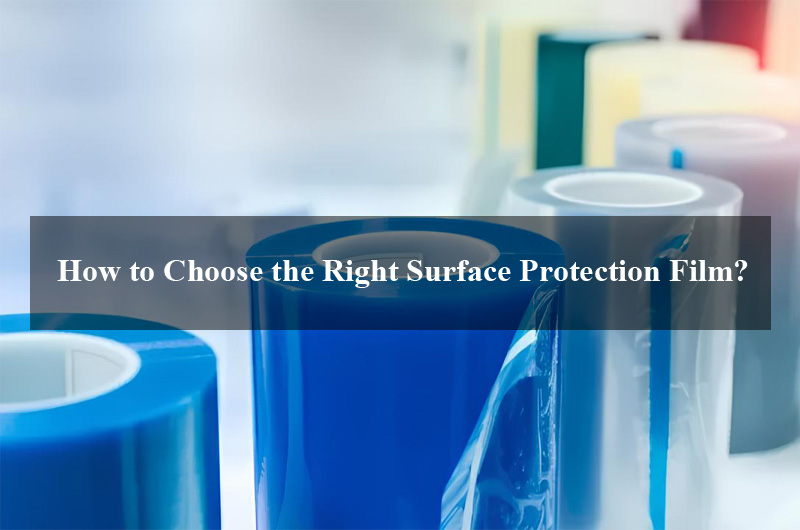
Choosing the wrong protection film can lead to serious problems, including adhesive residue, edge lifting, difficult removal, surface damage, and increased production costs.
So, how to choose the right surface protection film for your application?
In this article, we’ll outline the key factors to consider when choosing a protective film.
Why Choosing the Right Protection Film Matters
Many manufacturers focus only on the price of the film, but the actual performance of the protection film directly affects:
- Product appearance
- Production efficiency
- Transportation safety
- Customer satisfaction
- Rework and cleaning costs
A properly selected protection film should:
- Protect the surface effectively
- Peel off cleanly
- Maintain stable adhesion
- Resist environmental conditions
- Match the processing requirements
Choosing the right film can significantly reduce product damage and improve overall operational efficiency.
1. Understand the Surface Material
The first step in selecting a protection film is understanding the surface material.
Different materials require different adhesive strengths and film properties.
Common application materials include:
- Stainless steel
- Aluminum profiles
- Glass
- Acrylic sheets
- Plastic panels
- Painted surfaces
- Electronic components
For example:
- Mirror-finish stainless steel usually requires low-tack films
- Rough aluminum surfaces may need medium or high-tack films
- Acrylic sheets often require ultra-low adhesive strength to avoid residue
Surface sensitivity plays a critical role in film selection.
2. Choose the Correct Adhesive Strength
Adhesive strength is one of the most important factors in protective film performance.
Protective films are generally available in:
- Low tack
- Medium tack
- High tack
Low-Tack Films
Suitable for:
- Glossy surfaces
- Mirror stainless steel
- Acrylic sheets
- Decorative panels
Advantages:
- Easy removal
- Lower risk of adhesive residue
Medium-Tack Films
Suitable for:
- Aluminum sheets
- Coated metal surfaces
- General industrial applications
Advantages:
- Balanced adhesion
- Good processing stability
High-Tack Films
Suitable for:
- Textured surfaces
- Rough materials
- Heavy processing environments
Advantages:
- Strong holding power
- Better stability during transportation
However, excessive adhesive strength may cause residue problems, especially on sensitive surfaces.
3. Consider the Surface Finish
The texture and finish of the substrate greatly influence film selection.
Common surface finishes include:
- Mirror finish
- Brushed finish
- Matte finish
- Sandblasted finish
- Powder-coated surfaces
Smooth surfaces generally require lower adhesive strength because the contact area between the adhesive and substrate is larger.
Rough surfaces often require stronger adhesion to maintain stable bonding.
Incorrect matching between the film and surface finish can lead to:
- Edge lifting
- Air bubbles
- Difficult peeling
- Residue issues
4. Evaluate Processing Requirements
The manufacturing process also affects the choice of protective film.
Ask the following questions:
- Will the material undergo laser cutting?
- Is deep drawing or stamping involved?
- Will the product experience high temperatures?
- Is CNC machining required?
- Will the film remain during transportation?
For example:
- Laser cutting applications require heat-resistant films
- Deep drawing processes need flexible films with stable adhesion
- Outdoor transportation may require UV-resistant films
Choosing a film based only on surface type without considering processing conditions can create serious production problems.
5. Check Weather Resistance Requirements
If the protected product will be exposed to outdoor conditions, weather resistance becomes critical.
Environmental factors include:
- UV exposure
- Heat
- Humidity
- Rain
- Temperature changes
Poor weather resistance may cause:
- Adhesive aging
- Residue after removal
- Film cracking
- Edge lifting
For outdoor applications such as aluminum profiles, solar panels, or construction materials, UV-resistant protective films are highly recommended.
6. Determine the Required Protection Period
How long will the film stay on the surface?
This is an important question during film selection.
Short-term applications may only require standard films, while long-term storage or overseas shipping may require aging-resistant adhesive systems.
If the film remains on the surface too long:
- Adhesive may harden
- Residue risks increase
- Removal becomes difficult
Always select a film designed for the expected protection duration.
7. Consider Film Thickness
Protective films are offered in various thicknesses to suit different applications.
Thicker films generally provide:
- Better impact resistance
- Improved scratch protection
- Higher durability
Thinner films are often used for:
- Smooth surfaces
- Precision electronics
- Lightweight protection
Choosing the correct thickness depends on:
- Surface sensitivity
- Transportation risks
- Processing conditions
8. Test Compatibility Before Mass Production
Even if a film appears suitable on paper, real-world testing is essential.
Before large-scale application:
- Conduct adhesion tests
- Evaluate peel performance
- Test under actual environmental conditions
- Verify residue-free removal
Testing can help avoid:
- Production delays
- Surface damage
- Customer complaints
- Material waste
A small trial can prevent significant losses later.
Conclusion
Choosing the right surface protection film is essential for maintaining product quality, reducing damage, and improving manufacturing efficiency.
The ideal protective film should match:
- The substrate material
- Surface finish
- Processing conditions
- Environmental exposure
- Protection duration
Instead of focusing only on film price, manufacturers should evaluate the overall performance and compatibility of the protective film system.