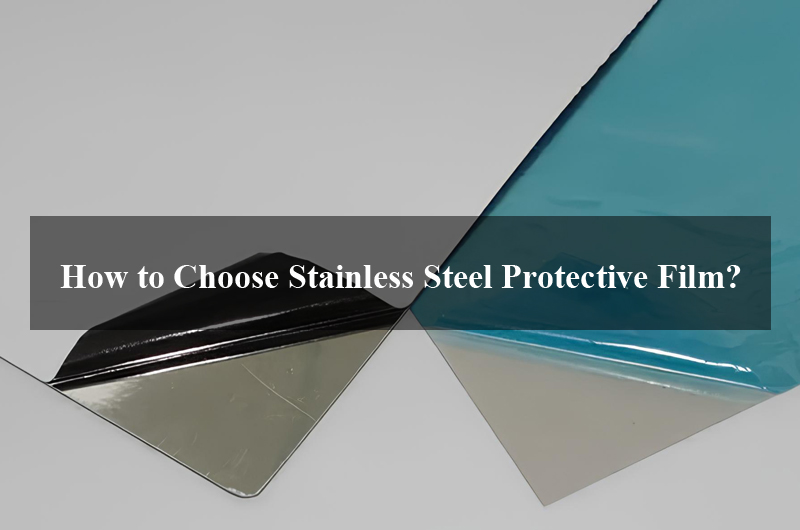
Stainless steel surfaces are highly vulnerable to scratches, fingerprints, dust, and damage during manufacturing, transportation, storage, and installation.
To maintain surface quality and reduce product loss, protective films are commonly applied to stainless steel sheets, coils, and finished products. However, choosing the wrong protective film can cause serious problems such as adhesive residue, edge lifting, difficult peeling, and surface contamination.
So, how do you choose the right surface protective film for stainless steel?
This article explains the key factors manufacturers and buyers should consider before selecting a protective film solution.
Why Stainless Steel Needs Protective Film
Although stainless steel is durable, its surface can still be easily damaged during processing and handling.
Common risks include:
- Scratches during fabrication
- Surface abrasion during transportation
- Fingerprints and contamination
- Damage during laser cutting or bending
- Surface defects during installation
These problems may lead to:
- Reduced product appearance
- Increased rework costs
- Customer complaints
- Lower production efficiency
Protective films help prevent these issues while maintaining the original finish of the stainless steel surface.
Understand the Stainless Steel Surface Finish
The surface finish is a key consideration when choosing a protective film. Different finishes require different adhesive strengths and film characteristics.
Common stainless steel finishes include:
- Mirror finish
- Brushed finish
- Hairline finish
- Matte finish
- Sandblasted finish
- BA finish
- No.4 finish
Smooth and glossy surfaces generally require lower adhesive strength, while rougher surfaces often require stronger adhesion.
Incorrect adhesive selection may cause:
- Residue problems
- Difficult removal
- Insufficient adhesion
- Edge lifting
1. Choose the Correct Adhesive Strength
Adhesive strength plays a critical role in stainless steel surface protection.
Protective films are usually classified as:
- Low tack
- Medium tack
- High tack
Low-Tack Protective Films
Suitable for:
- Mirror stainless steel
- Glossy decorative panels
- Sensitive polished surfaces
Advantages:
- Easy removal
- Lower risk of residue
- Better surface safety
However, low-tack films may not perform well on rough surfaces or during heavy processing.
Medium-Tack Protective Films
Suitable for:
- General stainless steel sheets
- Brushed finishes
- Standard industrial applications
Advantages:
- Balanced adhesion
- Good processing stability
- Reliable transportation protection
This is one of the most commonly used adhesive levels for stainless steel applications.
High-Tack Protective Films
Suitable for:
- Rough surfaces
- Deep drawing applications
- Heavy processing environments
Advantages:
- Strong holding power
- Better resistance to lifting during processing
However, excessive adhesion may increase the risk of adhesive residue, especially after heat exposure.
2. Consider Processing Requirements
Different manufacturing processes require different protective film performance.
Before selecting a film, consider whether the stainless steel will undergo:
- Laser cutting
- Bending
- Stamping
- Deep drawing
- CNC machining
- Roll forming
For example:
Laser Cutting Applications
Laser cutting generates heat that can affect the adhesive.
The film should:
- Resist heat
- Prevent edge burning
- Avoid adhesive transfer
Special laser-cutting protective films are often recommended.
Bending and Stamping Applications
During bending or stamping, the film must maintain flexibility and adhesion without cracking or peeling.
Films with strong elongation performance are preferred for these applications.
3. Evaluate Weather Resistance
If stainless steel products are stored outdoors or exposed to sunlight during transportation, weather resistance becomes very important.
Environmental exposure may cause:
- Adhesive aging
- Residue problems
- Film cracking
- Difficult peeling
High-quality stainless steel protective films should provide:
- UV resistance
- Temperature resistance
- Stable adhesive performance
This is especially important for:
- Construction materials
- Elevator panels
- Outdoor decorative stainless steel
4. Check Film Thickness
Film thickness affects protection performance.
Thicker films generally provide:
- Better scratch resistance
- Improved impact protection
- Higher durability
Thinner films are often used for:
- Precision decorative surfaces
- Light-duty protection
- Easy lamination
The correct thickness depends on:
- Surface sensitivity
- Transportation conditions
- Processing requirements
5. Ensure Clean Removability
One of the most important requirements for stainless steel protective film is clean removal.
The film should peel off easily without:
- Adhesive residue
- Surface marks
- Glue transfer
- Surface discoloration
Residue problems often occur because of:
- Excessive adhesive strength
- Long-term application
- Heat exposure
- Poor adhesive quality
Choosing a high-quality removable adhesive system is essential.
6. Match the Film to the Application Environment
Application conditions greatly affect film performance.
Consider factors such as:
- Indoor or outdoor use
- Storage duration
- Transportation temperature
- Humidity levels
- Exposure to sunlight
For long-distance shipping or outdoor storage, UV-resistant and aging-resistant films are strongly recommended.
How to Test Protective Film Compatibility
Before large-scale application, compatibility testing is highly recommended.
Manufacturers should:
- Test adhesion on actual stainless steel surfaces
- Simulate processing conditions
- Evaluate weather exposure performance
- Verify clean removal after storage
Testing helps prevent:
- Production delays
- Surface damage
- Customer complaints
- Material waste
A small trial can save significant costs later.
Conclusion
Choosing the right stainless steel protective film requires consideration of:
- Surface finish
- Adhesive strength
- Processing requirements
- Weather resistance
- Film thickness
- Application environment
The ideal protective film should provide strong surface protection while allowing clean and easy removal without damaging the stainless steel surface.