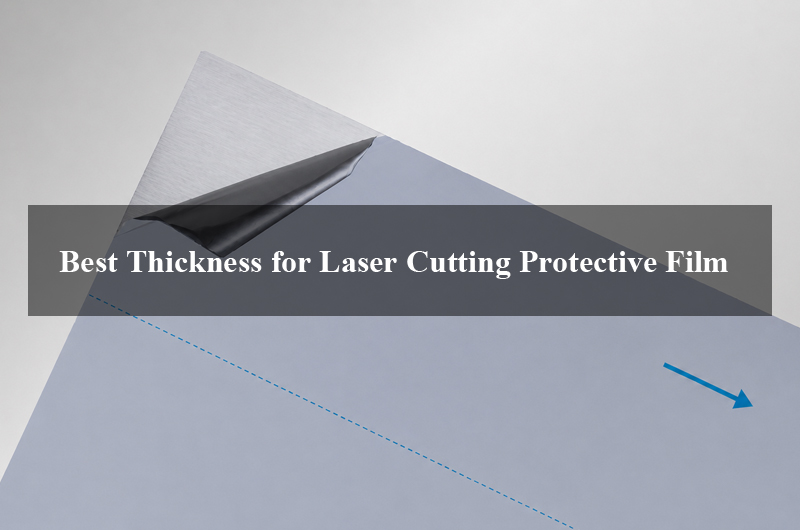
In industrial laser cutting applications, the wrong film thickness can lead to burning, edge lifting, adhesive residue, poor cutting quality, and unnecessary production costs.
Whether processing stainless steel, aluminum sheets, decorative metals, or galvanized steel, manufacturers must carefully select protective film thickness according to the material type, laser power, and processing conditions.
Why Film Thickness Matters in Laser Cutting
Protective film serves several important functions during laser processing:
- Protecting the metal surface from scratches
- Preventing contamination
- Reducing handling damage
- Improving appearance quality
- Minimizing cleaning after processing
However, the film is exposed to high temperatures and thermal stress during laser cutting. Film thickness directly affects how the protective layer reacts under these conditions.
If the film is too thin, it may:
- Burn easily
- Shrink near the cutting edge
- Lose adhesion stability
- Tear during removal
- Provide insufficient protection
If the film is too thick, it may:
- Interfere with cutting precision
- Cause edge carbonization
- Increase smoke generation
- Reduce cutting efficiency
- Affect laser focus performance
Selecting the correct thickness helps balance protection, heat resistance, and cutting performance.
Common Thickness Range for Laser Cutting Protective Film
Most laser cutting protective films are available within the following thickness range:
| Film Thickness | Typical Application |
|---|---|
| 30–50 microns | Light surface protection |
| 50–80 microns | General laser cutting |
| 80–120 microns | High-power laser cutting |
| 120+ microns | Heavy-duty industrial applications |
The ideal thickness depends on multiple factors including laser type, metal material, and processing environment.
Best Thickness for Stainless Steel Laser Cutting
Stainless steel is one of the most common materials in laser processing.
For decorative stainless steel and sheet metal fabrication, protective films usually require:
- Good heat resistance
- Stable adhesion
- Clean removability
- Scratch protection
In most applications, a thickness between 60 and 100 microns provides good performance.
Thin Films for Decorative Surfaces
For mirror-finish or decorative stainless steel, thinner films may provide better optical clarity and easier application.
However, extremely thin films may burn more easily during high-power laser cutting.
Medium Thickness for General Processing
Films around 80 microns are widely used because they offer:
- Better thermal stability
- Improved durability
- Reduced edge lifting
- Balanced flexibility
This thickness range works well for both fiber laser and CO2 laser cutting systems.
Best Thickness for Aluminum Laser Cutting
Aluminum surfaces are softer and more sensitive to scratches compared to stainless steel.
Protective films for aluminum laser cutting must provide:
- Excellent surface protection
- Controlled adhesion
- Heat resistance
- Easy peeling after cutting
Thickness between 60 and 100 microns is commonly recommended.
For high-speed fiber laser cutting, thicker films may improve thermal resistance and reduce burning around the cutting edge.
Best Thickness for High-Power Fiber Laser Cutting
Modern fiber laser systems operating above 6kW generate significantly higher thermal stress.
In these applications, thicker protective films are often necessary to improve heat resistance and cutting stability.
Typical recommended thickness:
- 80–120 microns
Benefits include:
- Better resistance to heat accumulation
- Reduced film deformation
- Lower risk of adhesive transfer
- Improved dimensional stability
However, excessively thick films may negatively affect cutting precision or edge quality if not properly matched to processing parameters.
Thin vs Thick Protective Film
Advantages of Thin Film
Thin protective films offer several benefits:
- Better flexibility
- Easier lamination
- Lower material cost
- Improved transparency
- Reduced air bubbles
They are suitable for:
- Light-duty applications
- Low-power laser systems
- Decorative metal surfaces
- Temporary indoor protection
Disadvantages of Thin Film
However, thin films may have limitations:
- Lower heat resistance
- Higher burn risk
- Easier tearing
- Reduced mechanical durability
Advantages of Thick Film
Thicker films provide:
- Better impact resistance
- Improved thermal stability
- Enhanced scratch protection
- Greater durability during processing
They are often preferred for:
- High-power laser cutting
- Heavy industrial processing
- Long production cycles
- Thick metal sheets
Disadvantages of Thick Film
Excessively thick films may create problems such as:
- Difficult application
- Increased material cost
- Reduced cutting precision
- Higher smoke generation
- More difficult peeling
The goal is to select a thickness that provides sufficient protection without negatively affecting cutting performance.
How Laser Power Affects Thickness Selection
Laser power is one of the most important factors in film thickness selection.
Low-Power Laser Systems
For low-power laser cutting below 3kW:
- Medium or thin films may perform well
- Heat exposure is relatively limited
- Burn risk is lower
Medium-Power Fiber Lasers
For systems between 3kW and 6kW:
- Moderate thickness is usually preferred
- Improved heat resistance becomes necessary
High-Power Fiber Lasers
For systems above 6kW:
- Heat-resistant thicker films are recommended
- Stable adhesive systems are critical
- Thermal deformation resistance becomes essential
Selecting insufficient film thickness for high-power laser systems often leads to burning, residue, and peeling problems.
Adhesive Performance and Thickness
Film thickness alone does not determine laser cutting performance. Adhesive formulation is equally important.
High-quality laser cutting protective films often use specially designed acrylic pressure-sensitive adhesives that provide:
- Stable adhesion
- Heat resistance
- Low residue
- Easy removability
Water-based acrylic adhesive systems are increasingly popular because they combine environmental benefits with excellent processing performance.
Even thicker films may fail during laser cutting if the adhesive system is not designed for thermal stability.
Recommended Thickness by Application
Decorative Stainless Steel
Recommended thickness:
- 60–80 microns
Aluminum Sheets
Recommended thickness:
- 60–100 microns
High-Power Fiber Laser Cutting
Recommended thickness:
- 80–120 microns
Heavy Industrial Metal Processing
Recommended thickness:
- 100+ microns
General Sheet Metal Fabrication
Recommended thickness:
- 70–90 microns
These recommendations may vary depending on machine settings, cutting speed, and environmental conditions.
Why Testing Is Important
Every laser cutting environment is different.
Factors such as:
- Laser brand
- Power level
- Assist gas
- Cutting speed
- Metal surface finish
- Storage temperature
can all influence protective film performance.
Before mass production, manufacturers should always conduct testing under actual processing conditions to determine the optimal film thickness and adhesive level.
Conclusion
Selecting the best thickness for laser cutting protective film is essential for achieving stable cutting performance, clean removal, and reliable surface protection.
In most laser cutting applications, medium-thickness films between 60 and 100 microns provide the best balance between flexibility, heat resistance, and protection.
For high-power fiber laser systems, thicker heat-resistant films may be necessary to prevent burning and adhesive residue.
However, film thickness should always be evaluated together with:
- Adhesive formulation
- Laser power
- Metal material
- Processing parameters